


Rhode Island has an implementation problem. In the four years since Governor Dan McKee signed the landmark Act on Climate, declaring that it “represents a commitment that not only addresses a moral imperative, but also presents a platform to enhance our economy, public health, environmental equity, and natural environment” (Act on Climate Press Release, 2021), the state has passed scant additional policies that would drive down emissions.
Now, environmental, labor, and business leaders are reeling after reviewing the Governor’s proposed FY 2027 Budget that attempts to yank out foundational policies needed to meet the Act on Climate.
Legislative Response to Proposed FY27 Budget
Recently, the Senate Finance Committee heard Article 11 of the proposed FY27 (H7127) budget, which includes all the changes to various clean energy programs the state has. Acting Commissioner Chris Kearns of the Office of Energy Resources (OER) and the Administrator of the Division of Public Utilities and Carriers (DPUC), Linda George, were present to defend the various sections included in the budget article. Their joint presentation included many claims about the state’s ability to procure offshore wind and meet the mandates in the Act on Climate.
Below, we will highlight and respond to some of the claims made at the hearing.
Comment by Acting Commissioner Kearns: “Once the Revolution Wind project goes live this year and the remaining capacity of the Vineyard Wind project with Massachusetts goes live, there is unlikely to be any new offshore wind development in the Northeast for the next decade.” (Senate Committee on Finance, 00:13:45-00:14:03)
Those of us in attendance were astonished to hear Commissioner Kearns say that. The statement shows an incredible lack of leadership in Rhode Island’s ability to lead and sustain the offshore wind market. Developers need clear signals that the state will be open for business. Remarks like this do the opposite, effectively hanging a “closed” sign on the door at a moment when state leadership and certainty are desperately needed by the market. This is not the Apollo Mission. Rhode Island has experience with offshore wind, and we can look to the thousands of wind turbines spinning offshore around the world. There is no doubt that this current time is not conducive to building offshore wind. However, this time will pass, and ten years is a very long time in the energy world. This is not a time to give up altogether. This statement by Commissioner Kearns is exactly why we need the legislature to require a commission to study and develop a solid plan towards the goal of over 1,000 MW as soon as possible, which is one of our priority bills (H7727) this session.
It should be noted that Rhode Island has had multiple opportunities to solicit more offshore wind and has repeatedly failed to follow through. In July 2022, the Rhode Island General Assembly passed legislation requiring Rhode Island Energy to procure 600-1,000 MW of offshore wind under Section 39-31-10 of the ACES Act. Rhode Island Energy initially selected Orsted's Revolution Wind 2 project (now Starboard Wind) for 884 MW but walked away from negotiating a power purchase agreement as they felt the project did not meet all of the ACES requirements (particularly that the price was not commercially reasonable according to them). Since then, the price of power generated from natural gas has soared.
In 2025, Rhode Island issued another RFP for 1,200MW as part of a tri-state solicitation with Connecticut and Massachusetts, totaling 6,800 MW up for auction. Despite receiving five bids totaling 5,492MW, Rhode Island only selected a meager 200 MW from the SouthCoast wind project. Even worse, they ultimately ended up walking away from even those 200 MW late last year.
While there are very real challenges around federal permitting of offshore wind right now, we believe this will ultimately be a blip in the timeline. Offshore wind remains essential to Rhode Island’s climate, economic, and energy reliability and independence goals. For these reasons, the General Assembly must establish a study commission to identify clear pathways to get the state and the offshore wind industry back on track in a post–Trump administration landscape, and to determine what Rhode Island can and should be doing now to prepare for that future.
Aside from offshore wind, Rhode Island also has the opportunity to keep building its solar capacity while growing clean energy jobs within the state. This will grow local clean energy resources and jobs, ultimately bringing the state closer to meeting the RES. By contrast, the governor’s proposed budget would decimate the solar industry in Rhode Island.
It’s more than disappointing to see the individuals tasked with moving the state closer to a clean energy future wither away from our climate mandates during the very time state leadership is needed the most.
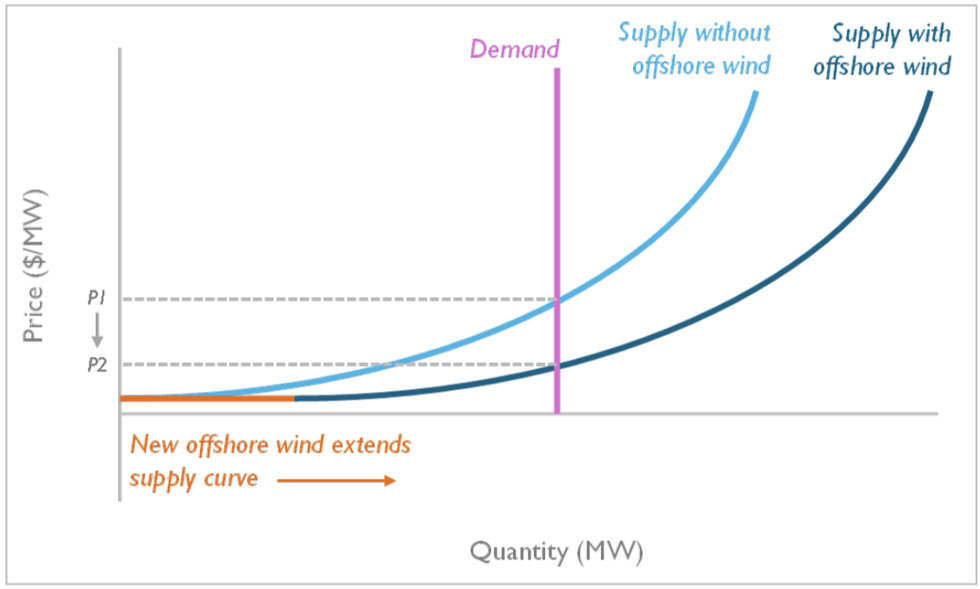
Figure 1: This graph shows the price suppression effects of offshore wind. Adding this resource lowers the price for all electricity in the wholesale market when wind is generating. Charting the Wind: Quantifying the Ratepayer, Climate, and Public Health Benefits of Offshore Wind in New England, Synapse Energy Economics p. 6.
Comment by Administrator George: “All parties involved in reviewing th[e] [energy efficiency program] supported a reduction: the utility company, the Division, ...the Office of Energy Resources, the Energy Efficiency Council, the Public Utilities Commission.” (Senate Committee on Finance, 00:29:45-00:30:03)
Contrary to what Administrator George, not all parties involved in the development of the 2026 Energy Efficiency Plan were in agreement with the budget cuts. The Energy Efficiency Council, which is the stakeholder body appointed by the Governor to evaluate energy efficiency programs, reviewed the proposed plan and strongly opposed the budget cuts, ultimately putting forth an alternative budget proposal. In the hearings for the 2026 Energy Efficiency Plan, the Council’s decision to not endorse the Plan developed by Rhode Island Energy, and the Council’s alternative proposal was discussed (Pre-Filed Direct Testimony of Peter Gill Case, Docket No. 25-37-EE, p. 6). Ultimately, the Public Utilities Commission approved the 2026 Energy Efficiency Plan proposed by Rhode Island Energy.
Additionally, there were multiple stakeholder groups that submitted comments throughout the development of the 2026 EE plan opposed to the budget cuts, which can be reviewed here. This claim by Administrator George misrepresents the interests of those involved in the development of the plan.
At the hearing, State Senator Samuel Zurier (District 3) asked some excellent questions on the disconnect between the governor’s proposed budget and the Climate Action Strategy.
Comment of Senator Zurier:
“If [the Office of Energy Resources] [was] working on a change in the [Renewable Energy Standard], don’t you think that would have been useful to tell the EC4 so they could have adjusted their [2025 Climate Action Strategy] and their models?“ (Senate Committee on Finance, 00:43:14-00:43:27).
“Since the Renewable Energy Standard is basically the foundation of the entire Act on Climate then viewing in isolation the Governor’s suggestion to extend it to 2050, will by itself make the successful implementation of the Act on Climate impossible” (Senate Committee on Finance, 1:21:00-1:21:17).
We agree with Senator Zurier’s apt assessment of the FY2027 Budget and how it compares to the 2025 Climate Action Strategy, which we found to be disappointing. The Governor has put forth a budget that directly contradicts the implementation suggestions in the Rhode Island Climate Action Strategy (RICAS). This is an irresponsible and bad-faith action that undermines the Act on Climate. It is also extremely disrespectful to stakeholders such as Green Energy Consumers Alliance that put many long hours into the CAS process over several months. To be clear, the RICAS was finalized in late December, and it did not state that Rhode Island should backslide at all with respect to the Act on Climate, the Renewable Energy Standard, and energy efficiency. The minimal CAS material released for public comment prior to the finalization of the plan highlighted the importance of the state’s current policies in ensuring Rhode Island was on a trajectory to meeting the Act on Climate, specifically the 2030 mandate.
What's at Stake
Having a requirement for releasing reports on climate action in the Act on Climate is a good thing, it ensures the state assesses available policy options for development and brings stakeholders into the process of mitigating and adapting to climate change. However, the state has a prior climate plan (2022 Climate Update) that also included suggestions for policy development that would help the state meet the Act on Climate. Unfortunately, few, if any, policies have been implemented since that plan was released four years ago. Instead, state agencies and lawmakers have pushed off taking action until the release of the 2025 RICAS, which we now know contains many of the same policy suggestions.
The lack of 2022 Climate Update policy implementation and the disregard for the policies included in the 2025 RICAS is what will make Commissioner Kearn’s statements a self-fulfilling prophecy.
Proposals in Article 11
Article 11 Section 3: Energy Efficiency Program Cap
-
This section proposes to create a $75M cap on the utility’s gas and electric energy efficiency programs, a significant reduction from prior program years.
-
If approved, this budget cap would be 48% below the average budget level over the past five years (Clean Energy is Affordable Energy Press Event, 03:53).
-
-
Why this is bad: RIE’s energy efficiency programs go through rigorous cost-benefit testing and produce $3 of benefits for every $1 invested (2025 Energy Efficiency Council Annual Report, p. 18). Artificially capping the program budgets could result in ratepayers paying more for energy than reducing their demand.
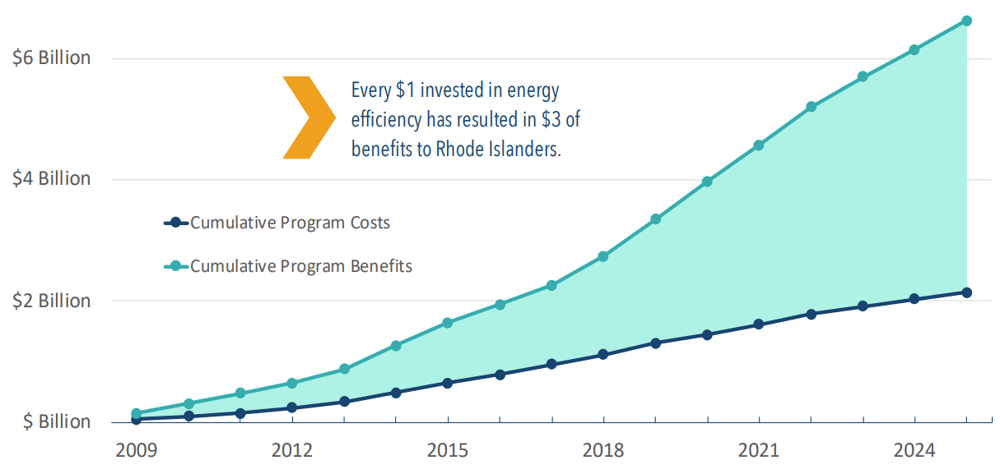
Figure 2: Value of energy efficiency investments between 2009 and 2025. Rhode Island Energy Efficiency Council Annual Report, p. 18.
Article 11 Section 8: Renewable Energy Standard Adjustments
-
This section would push out the RES by 17 years, to 2050.
-
Lowers the Alternative Compliance Payment (penalty for obligated entities that do not meet their renewable energy standard obligations) from $86.31 to:
-
$40.00/MW for “new” renewable energy resources; and
-
$11.00/MW for “existing” renewable energy resources.
-
Note: see page ES-2 of this report for definitions of “new” and “existing” renewable energy resources.
-
-
Expands the percentage of “existing” resources that can be used to fulfill RES obligation from 2% to 25%.
-
Why this is bad: The current RES schedule is a foundational policy to reducing emissions in line with the Act on Climate. Pushing it out will almost certainly prevent the state from meeting the 2030 mandate. Allowing more “existing” resources to count towards the RES could suppress development of additional new renewable resources.
Article 11 Section 10: Solar Development and Net Metering Changes
-
Adds a monthly “grid access fee” to large-scale (>1MW) solar developments.
-
Adjust the credit for net metering projects from the retail rate to the July 2026 rate, one of the lowest compensation months of the year.
-
Why this is bad: the monthly grid fee and the change in net metering compensation could result in existing solar projects no longer being financially viable and could prevent future projects from being built. In an environment where offshore wind is difficult to procure, the state should reinforce its commitment to developing the renewable energy it can, rather than hamstring an existing industry.
-
Note: There should be an alternative proposal to this budget article being developed prior to the budget being passed and we will update this blog when it becomes available.
What You Can Do
Contact your local legislators and state leaders and call on them to oppose the proposals in Article 11. Find your local legislators here or call our state leaders using the numbers below.
Governor Daniel McKee’s office: (401) 222-2080
House Speaker Joseph Shekari’s office: (401) 222-2447
Senate President Valerie Lawson’s office: (401) 222-4901
Here's what you can say in a call or email to your legislators: “Hello, my name is [Name], and I live in [City/Town], RI. I am calling to ask [Your Representative/Your Senator] to oppose Sections 3, 8, and 10 in Article 11 of the Governor’s proposed Fiscal Year 2027 Budget.”
The governor proposed this budget, but now it is up to the General Assembly to reject it. When reaching out, feel free to add a personal story about why you feel the state must continue to reduce emissions and meet out Act on Climate mandates. Don't feel like you need to explain exactly what the budget sections do; focus on why you care about climate action.
If you have any questions or take action, feel free to reach out to Rhode Island Policy Advocate, Tina Munter at: Tina@GreenEnergyConsumers.org.
Comments