

The Executive Climate Change Coordinating Council (EC4) has approved the final 2025 Climate Action Strategy (CAS) and will send it to the General Assembly and the Governor’s office. The final plan falls short of being a strategy. Unfortunately, we had low expectations after reading the draft executive summary.
The CAS is based on very questionable assumptions.
The Strategy was required under the Act on Climate (AOC) and was supposed to be a plan that charted a course of action that would ensure Rhode Island is able to meet the statutory requirements of the AOC – specifically, meeting the 2030 mandate of reducing statewide emissions 45% below 1990 levels. The Strategy proclaims RI will do so based on a faulty assumption that the state will be able to enforce all current policies that the state has adopted thus far to reduce emissions. These keystone policies include the 100% Renewable Energy Standard (RES), Advanced Clean Cars II (ACCII) and Advanced Clean Trucks (ACT) regulations, and programs like Clean Heat Rhode Island, which provides heat pump purchase incentives.
Unfortunately, the federal administration repealed the waiver that allowed states to implement ACCII and ACT regulations, and it’s unclear how long that issue will take to be litigated and whether states will prevail. The CAS discusses costs associated with the RES and potential headwinds with the buildout of new renewable energy resources and writes that “the State should consider updates” (RI 2025 Climate Action Strategy, p. 130) to the policy, which we interpret as a suggestion to weaken it. To be clear, the RES is a critical policy, and any adjustment to its stringency would greatly reduce RI’s ability to meet the AOC. Clean Heat Rhode Island is relied on as a key policy to increase heat pump adoption, but no commitment to a program funding level is made in the report, and funding has been allocated ad hoc in prior years. We see this disconnection between carbon reduction strategies and firm commitments to be greatly disappointing. This reliance on unenforceable or weakened policies is a major, fatal flaw in the Strategy.
Furthermore, according to the AOC, the state’s climate plans can direct a state agency to promulgate the regulations “necessary to meet the greenhouse gas emission reduction mandate” (R.I. Gen. Laws § 42-6.2-8), but the CAS did not do so. The EC4 made the choice to avoid assigning direct responsibility to agencies. The AOC requires what the state really needs: clear, actionable steps towards emissions reductions. On this test, too, the EC4 failed.
The Public Utilities Commission (PUC) has a major role, but you would not know it from reading the Climate Action Strategy
Alongside the development of the CAS, the PUC has been working on its final Future of Gas (FOG) report, required by Docket No. 22-01-NG, which opened over three years ago! For a refresher, the FOG docket explored the regulated gas distribution business in light of the Act on Climate, and stakeholders are anticipating the final report to include strategies for reducing gas consumption and unnecessary investment in gas infrastructure. The lack of a final Future of Gas report greatly hampers the public’s understanding of the CAS, as lacking a FOG report means that Rhode Islanders aren’t aware of the strategies that could be developed that would encourage electrification of end-use devices like heat pumps, heat pump water heaters, induction stoves, and clothes dryers and are viable alternatives to installing fossil fuel equipment.
Rhode Islanders need strategies like rate reform and time-varying electric rates that incentivize heat pump use and off-peak electric vehicle charging to ensure electrification is attainable and affordable. Rate reform can include measures like developing heat pump-specific electricity rates that reduce electricity costs for heat pump owners, and time-varying rates can be implemented once advanced meters are installed. Time-varying rates are rate structures that reflect the dynamic nature of electricity costs and can better align the cost to serve ratepayers with the costs they impose on the grid. Time-varying rates can also encourage ratepayers to adjust their electricity consumption based on current costs.
These are all issues under the purview of the PUC.
Note: Rhode Island Energy has filed for electricity and gas rate increases. In 2026, Green Energy Consumers will be working with allies to encourage the PUC to use the rate case as an opportunity to innovate in ways that would serve the public interest in terms of both affordability and pollution reduction.
The Risk With 2030
The CAS lacks a thorough explanation for how the state’s emissions in 2025 have been calculated. The most recent statewide greenhouse gas inventory was published this fall with data for emissions in 2023. The state’s annual report is released on a two-year delay from the current year due to data collection and reporting constraints and data for 2024 and 2025 has not yet been calculated or made public. The state inventory is also the official inventory, so we are relying on the CAS to model statewide emissions for those years.
One can download the excel spreadsheet: RI CAS Economy-Wide Modeling Results from the state’s website and review the “Annual Emissions by Sector” tab to review statewide emissions estimates under various scenarios. However, it’s unclear how emissions reductions by end-use device were calculated
In the CAS, it was projected that emissions would decline 5.25% from 2023 to 2024 and 5.65% from 2024 to 2025. These emissions reductions are a significant departure from the typical trajectory of RI’s emissions, which have never declined that significantly on an annual basis, excluding the impact of the pandemic on emissions reductions. In fact, the most recent Greenhouse Gas (GHG) Inventory reported that statewide “emissions have dropped 5.4% in the last five years. A similar rate of decrease between 2024 and 2030 would not allow the state to achieve the Act on Climate’s requirement of 45% below 1990 levels by 2030” (2023 Rhode Island GHG Inventory p. 25, emphasis added). Without understanding how emissions reductions between 2023-2025 were calculated, we cannot believe that Rhode Island will reach the projected level of emissions used in the CAS in 2025. If we are correct, then the state has further to go between now and 2030 than the Strategy is suggesting.
Table depicting RI’s annual emissions from 2022-2025, and the annual rate of change in emissions:
| 2020 (actual) | 2021 (actual) | 2022 (actual) | 2023 (actual) | 2024 (projected) | 2025 (projected) | |
| Net emissions (MMT CO2e) | 8.81 | 9.69 | 9.39 | 9.52 | 9.02 | 8.51 |
| Annual rate of change | -12.25% | +9.98% | -3.19% | +1.49% | -5.25% | -5.65% |
| Emissions for 2024 and 2025 are estimates and were taken from E3’s Rhode Island Climate Action Strategy Economy-Wide Modeling Results spreadsheet, available to download here. Emissions from 2020-2023 are from the Rhode Island Department of Environmental Management Annual Greenhouse Gas Inventories. Emissions from 2020-2023 can be seen on pg. 27 of the 2023 Inventory. | ||||||
This implementation risk associated with keystone policies in the CAS means that RI’s ability to meet the 2030 AOC target is significantly uncertain. The CAS even states “that without ACCII and ACT, Rhode Island is estimated to reduce GHG emissions by 43% below 1990 levels by 2030 – falling short of the 45% target” (RI 2025 Climate Action Strategy, p. 21). While EC4 makes that acknowledgement, there are no recommendations as to whether or when the state should develop mitigation options to ensure RI will be able to meet 2030 absent ACCII and ACT. One does not have to be an astute observer of national politics to realize that the Trump administration is not going to allow ACCII and ACT to proceed under their watch. Therefore, the Strategy’s lack of recommendations on how the state can fill that gap paints an overly rosy picture regarding the status of greenhouse gas reduction in the state and sets RI up for failure in the long term. To be clear, Green Energy Consumers is questioning both the math and the mindset.
What Can We Take from the Climate Action Strategy?
The sector where Rhode Island has the most control over reducing emissions is the building sector. The CAS includes the following bar graph to show how heat pump adoption must change in order for the state to meet the 2030 AOC mandate. However, the Strategy does not make a firm commitment to saying what policies the state must implement to drive this level of adoption.
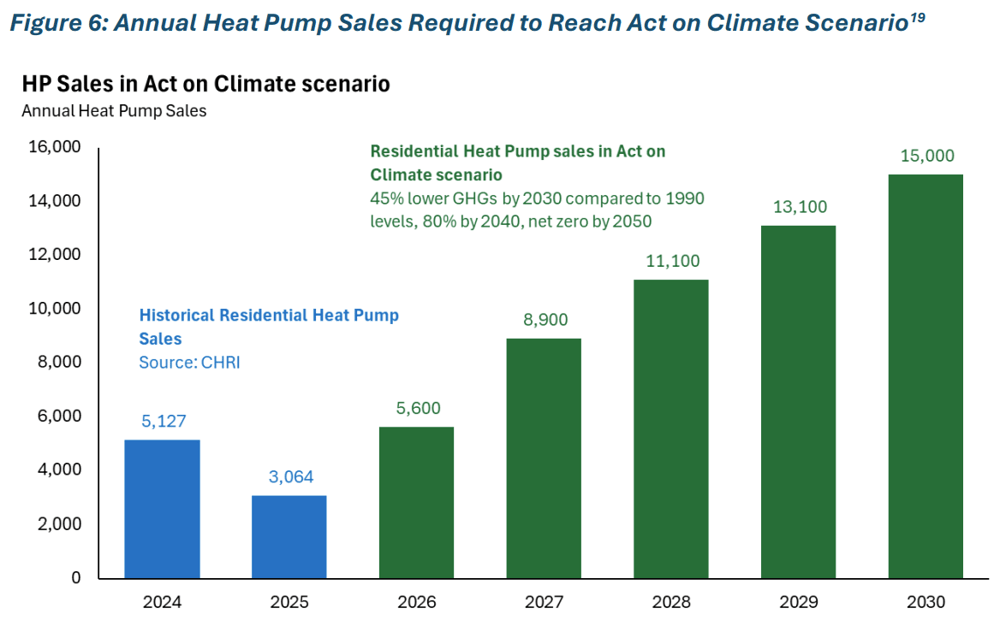
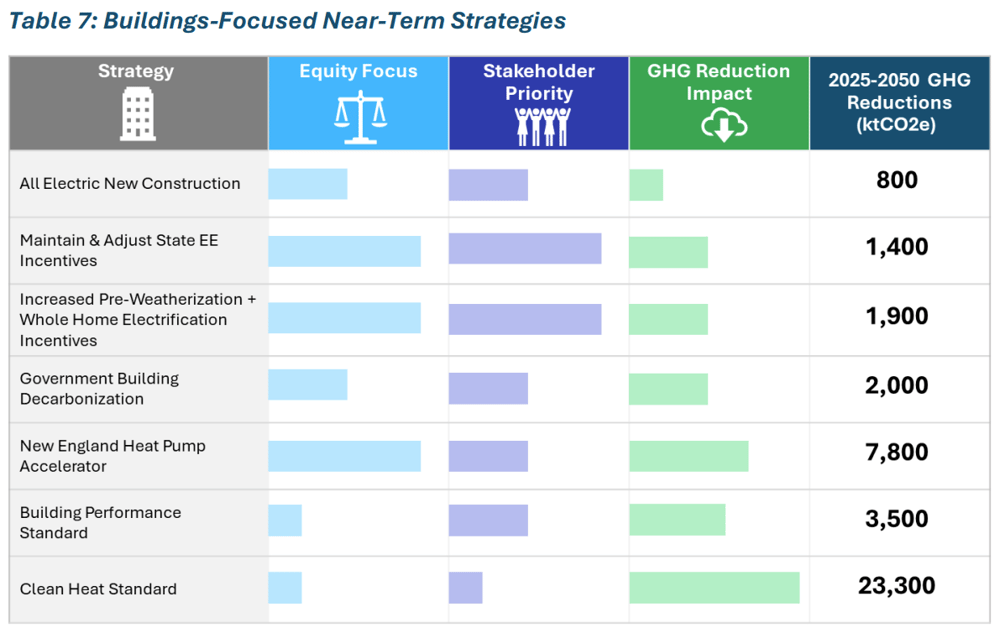
Due to the five-fold increase in heat pump adoption that will be needed to meet the 2030 mandate, the state must begin evaluating how agencies can utilize the building-specific policies in the CAS this year. The table below, included in the report, is a non-comprehensive list of policies that would reduce emissions specifically from the building sector, and we are looking forward to working with legislators to advocate for many of these policies in the new year. Rhode Island should pursue all of the strategies listed below to begin decarbonizing the building sector because with multiple strategies in play, no single strategy needs to be overly stringent on achieving emissions reductions. We will break down these policies and our thoughts on their role in decarbonizing RI’s environment.
All-electric new construction
This policy would be particularly impactful in ensuring that the state does not continue to invest in new fossil fuel infrastructure. Curbing the expansion of the gas distribution system will ensure that Rhode Island can develop a plan to manage the transition away from natural gas and protect ratepayers from paying for line extension allowances, a policy that allows new gas customers to be connected to the main gas line at low or no cost, paid for by all other ratepayers.
One alternative to an all-electric new construction policy is implementing a stretch code, which is a building code that exceeds the requirements of the base code. Rhode Island does have voluntary residential and commercial stretch codes finalized in 2018, but it is unclear how many buildings are constructed adhering to the stretch code. Residential and commercial stretch codes should be updated to reflect the new base building codes, specifically the 2024 International Energy Conservation Code (IECC).
Maintain and adjust state energy efficiency incentives
Rhode Island has a utility-operated energy efficiency program that provides incentives for electric equipment like heat pumps, heat pump water heaters (HPWH), and smart technologies that are intended to help ratepayers reduce their energy usage. Qualifying customers can also receive home energy upgrades via the income-eligible services program, which provides equipment upgrades at no cost to the customer. However, the energy efficiency programs offered by Rhode Island Energy (RIE) continue to incentivize high-efficiency gas equipment. While using high-efficiency equipment reduces the amount of fossil fuel consumed by a customer, RIE’s energy efficiency programs should focus on increasing the number of heat pump and HPWH installations to move customers away from gas usage. Furthermore, the 2026 efficiency plan approved by the Public Utilities Commission will operate with a smaller budget than in 2025, which will lead to a decrease in program benefits and GHG reductions.
Increased pre-weatherization and whole-home electrification incentives
One existing program the state has to fund home electrification incentives is the Clean Heat RI (CHRI) program. CHRI is a critical program to drive down the cost of heat pump installations and is run by the Office of Energy Resources (OER). However, there has been no commitment to a guaranteed funding level for CHRI in the CAS. OER must commit to a specific funding level to ensure the program is reliable for homeowners looking to install a system. Currently, funding is allocated intermittently from Regional Greenhouse Gas Initiative auction sale proceeds, and the program has paused at times when the number of applicants exceeds available funding. Without a commitment to a specific funding level, the state cannot depend on the CHRI program to incentivize and increase heat pump adoption in Rhode Island.
Government building decarbonization
OER is undertaking the benchmarking of state buildings (meaning, gathering data on existing emissions) and does energy efficiency improvements as necessary, but building decarbonization beyond government buildings is necessary for Rhode Island to meet the mandates in the AOC. In the long run, more efficient state buildings will save taxpayers money and improve the health of building occupants, including students.
Building Performance Standards and a Clean Heat Standard
These complementary policies would contribute to reducing emissions from the building sector, with a building performance standard (BPS) focusing on large buildings (>25,000 square feet) and a CHS supporting the decarbonization of all buildings. Both policies would contribute significantly to reducing GHG emissions and could be phased in over the next few years to ensure building owners are aware of the policy and viable compliance pathways and can plan ahead. These policies should be in place by 2028 so that emissions can start declining in 2029, ensuring RI on track to the 2030 AOC mandate.
The most significant policy modeled throughout the Strategy is a Clean Heat Standard (CHS), which is a policy that would require sellers of fossil fuels (propane, heating oil, natural gas) to deliver an increasing amount of clean heat services (weatherization, heat pumps, etc.) to their customers. The objective is to incentivize clean heating solutions and to ensure fossil fuel businesses can transition to clean heating services in the future. Page 83 of the technical appendix (available to download here) explains that the Rhode Island Department of Environmental Management (RIDEM), OER, and the PUC would have the authority to develop and implement a CHS program.
Rhode Island has had legislation introduced for several years that would direct a CHS program to be created, and we hope to see the RIDEM, OER, and the PUC develop this policy in 2026. To be clear, state agencies have the authority to develop a CHS via the Act on Climate, but have not yet utilized that authority. This lack of movement is why we are supporting CHS legislation again in 2026. Starting to develop this policy in the new year doesn’t mean it has to go into effect immediately. Rather, Rhode Island can begin the process of developing records of obligated entities and determine the speed with which emissions need to decline to ensure the thermal sector is on track to meet the AOC.
Where Do We Go Now?
Earlier in this blog, we wrote about the immense increase in heat pump adoption that is needed to meet the 2030 AOC mandate. We are saying that it’s inexcusable that EC4 would fail to connect the dots between the 15,000 heat pump figure and specific policies needed to reach that figure. So, we will connect the dots for you: Without a robust combination of increased funding for Clean Heat Rhode Island, the establishment of a Clean Heat Standard, and Building Performance Standards for large buildings, we estimate the state’s chances of reaching 45% emissions reductions by 2030 are slim. State agencies and the EC4 must work together to implement each of the policies we just wrote about in order to drive heat pump adoption at the level needed to reduce emissions from the building sector and allow the state to meet the 2030 AOC mandate. Not to mention coming up with a Plan B for the unenforceable regulations the Strategy relies on.
Was the CAS that was approved by the EC4 and sent to the General Assembly and the Governor what climate advocates worked for? No. In fact, at the public meeting where the EC4 voted to approve the plan, they did so without any discussion about the public comments made immediately preceding the vote and without making substantive edits to the content of the CAS. It is tempting to consider the CAS water under the bridge. However, Rhode Islanders now have a Strategy that does include modeling on the impact of several significant decarbonization policies that the state could develop. Now is the time to take those strategies to the State House and advocate for them to be passed legislatively, ensuring that state agencies, departments, councils, and commissions actually do their part to ensure Rhode Island is on track to reduce emissions 45% by 2030. We will also be intervening in cases before the Public Utilities Commission.
But we cannot do this alone. Stay tuned for how you can help.
Comments