
.jpg?width=30&name=larry%20(1).jpg)
Everyone has been talking about why energy bills have gone up. Thanks to a ton of disinformation coming from the fossil fuel and utility industries, too much blame has been placed on clean energy. That intentional disinformation has caused a tremendous amount of misinformation to be spread by people who, unfortunately, fall for the disinformation.
So, in the spirit of clearing things up, let’s look at this brand new report, Retail Electricity Price Trends and Drivers from Lawrence Berkeley National Laboratories (LBL) and the Brattle Group. As one of the authors, Ryan Wiser, posted:
“…natural gas prices are variable, and fluctuations flow through to wholesale and retail electricity prices. Those states more exposed to natural gas price swings also have more significant year-over-year variability in retail electricity prices. In 2025, wholesale prices jumped in ISO-NE (emphasis added because this is the New England power grid), NYISO, PJM, and MISO due to gas-price increases; we found that the increased price for natural gas in 2025 increased retail prices in ~ 21 states.”
This graph shows the striking relationship between natural gas and electricity prices over the last few years. The highest point came as a result of Russia’s invasion of Ukraine.
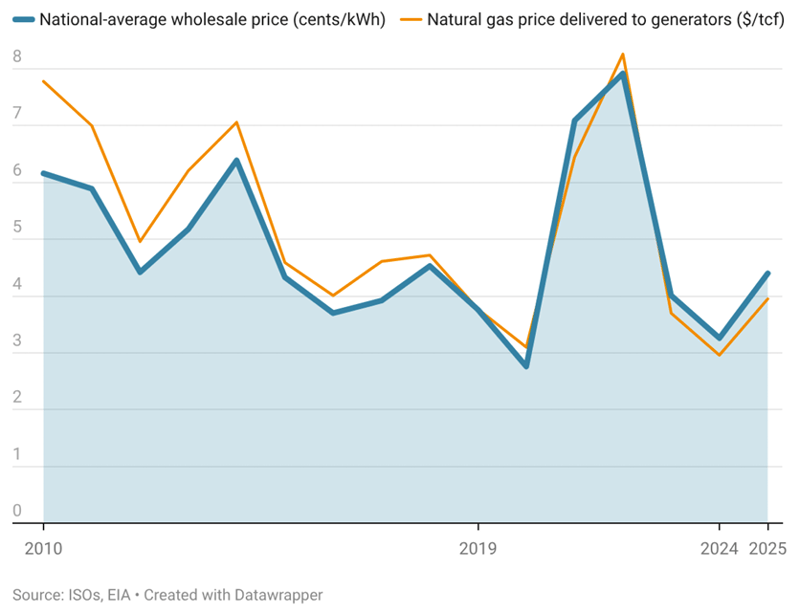 Load-weighted average real-time wholesale price, in cents/kWh inflation-adjusted for 2025$, compared to natural gas prices in $/tfc
The paper then shows how wholesale electricity prices changed from 2024 to 2025 by region. New England saw the largest increase in power prices, driven by a sharper rise in natural gas costs than seen in other regions. This reflects our region’s heavy reliance on natural gas, especially when it’s cold, increasing demand for both heating and power.
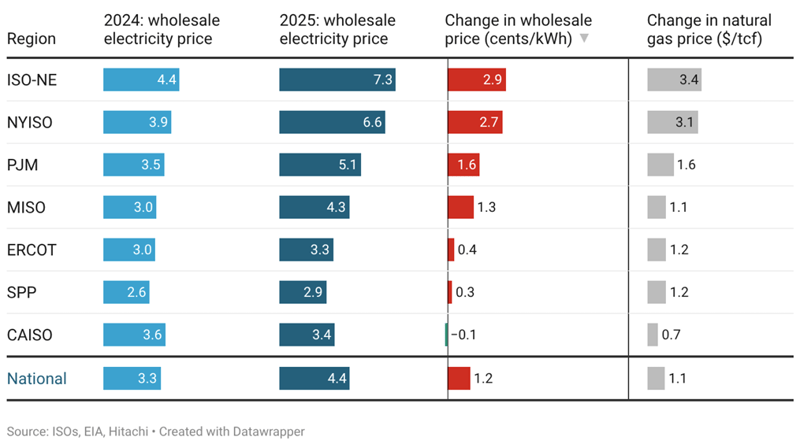 Load-weighted average real-time wholesale price and price change, in cents/kWh inflation-adjusted for 2025$, compared to the year-over-year change in regional natural gas hub prices
ISO-NE produces useful, concise, monthly reports on wholesale electricity demand and prices in New England. As you read through them, you will see how the average monthly price correlates strongly with electricity demand but also cold weather, because gas heating obviously consumes a lot of gas in the winter, leaving less available for power than the rest of the year.
Furthermore, the average price is greatly influenced by a relatively small number of peak-demand hours each winter (and in summertime, when air-conditioning load increases). Here are the numbers from the last few reports, including January and February, which had higher wholesale prices than those featured in the LBL paper.
|
Month |
Average Price per KWh (cents) |
|
November 2025 |
6.1 |
|
December 2025 |
13.0 |
|
January 2026 |
15.5 |
|
February 2026 |
12.7 |
The fossil fuel companies say that we can lower the price of natural gas by importing more of it from other parts of the country. We disagree. The numbers from this past winter that you see above would have been significantly lower had large offshore wind projects like Vineyard Wind and Revolution Wind been fully online the entire winter. But the White House took illegal actions to stop those projects, or at least slow them down (which, if successful, would cost ratepayers an added $45 billion over the next 10 years). Fortunately, the courts granted preliminary injunctions, and the projects have resumed construction. Other clean energy resources—efficiency, demand response, solar, and hydro— also help to suppress power prices.
At the state level, in Massachusetts and Rhode Island, legislators and governors should take whatever time is left in their sessions to pass bills that would save consumers money by reducing our dependence upon natural gas.
P.S. For more information on price suppression, please visit this blog (with a great video).
Comments