

Renewable energy offers several benefits, from public health to energy independence. One of the most powerful advantages, however, is its ability to lower the price of electricity on the wholesale market. This effect is called price suppression, and it’s why renewable energy is key to energy affordability.
Watch our 2-minute video on renewable energy and the price suppression effect!
This video serves as an introduction to the complex topic of price suppression. Read on to dive deeper.
ISO New England (ISO-NE), the grid operator, uses the regional wholesale electricity market to decide which energy resources will be used to meet energy demand. Natural gas, oil, nuclear, and renewables like wind, hydro, and solar are all on the menu. ISO-NE decides which type of supply will be called upon first based on its price, from cheapest to most expensive, and orders them into a “supply stack”. Oil and natural gas tend to be the most expensive supply type because they need to recover the price of their fuel, and the operation and maintenance of their power plants is costly. Renewables, on the other hand, have no fuel costs because wind, water, and the sun are free. This allows wind, hydro, and solar to bid into the wholesale market at nearly $0/MWh, meaning they are going to operate and sell power to the grid as long as the wind is blowing, the sun is shining, or water is flowing.
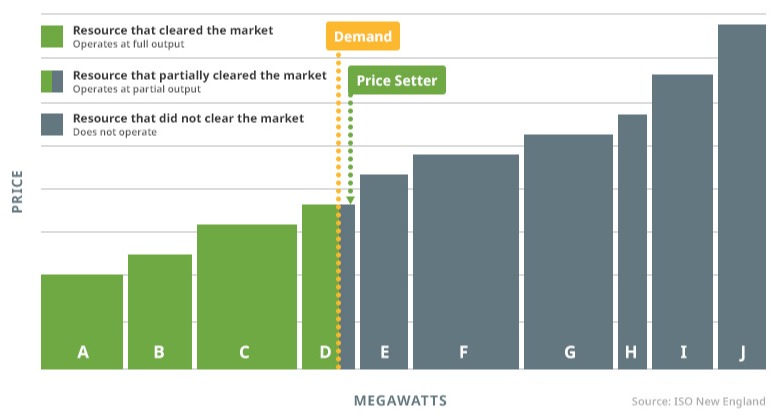 This graph illustrates the supply stack for the wholesale energy market. Each resource bids into the market, and ISO-NE orders them from least (A) to most (J) expensive. The last resource needed to meet demand, which sets the clearing price (D), is called the marginal resource. Source: How Resources Are Selected and Prices Are Set in the Wholesale Energy Markets, ISO New England.
Since renewables are the cheapest option on the wholesale market, ISO-NE places them at the front of the supply stack, followed by other sources, including natural gas and oil, at varying costs. This means that renewables are called on first (i.e. position A in Figure 1), with more expensive supply types making up the remaining energy needed to meet demand. The last, and most expensive, resource needed to close the gap between supply and demand is called the marginal resource, and it sets the clearing price. The clearing price sets the price of electricity for the entire wholesale market. As demand increases, ISO-NE must call up increasingly expensive resources. Therefore, adding more renewable energy to the front of the stack displaces the most expensive sources and lowers the clearing price.
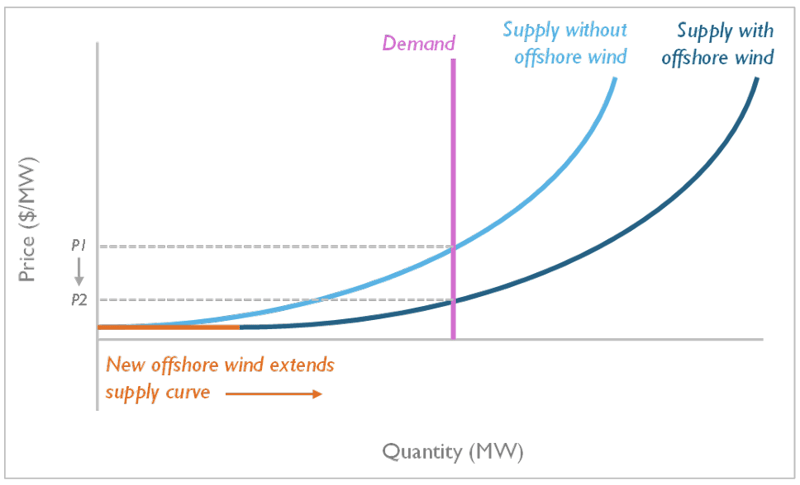 This graph shows the price suppression effects of offshore wind, but the same effect occurs with hydro and solar, which also lack fuel costs. Adding renewable energy lowers the price of all electricity in the wholesale market. Especially in the winter when the wind is blowing, and in the summer when the sun is shining. Source: Charting the Wind: Quantifying the Ratepayer, Climate, and Public Health Benefits of Offshore Wind in New England, Synapse Energy Economics, p.6.
When put to the test, price suppression is proven to save rate payers millions in avoided energy costs. A 2025 Daymark study found that if 3,500 MW of contracted offshore wind had been operational during the winter of 2024, ratepayers could have saved around $400 million. These savings show up not because 3.5MW of offshore wind would have completely replaced natural gas, but because it would limit the number of hours that dirtier, more expensive fuels get called upon and raise the clearing price.
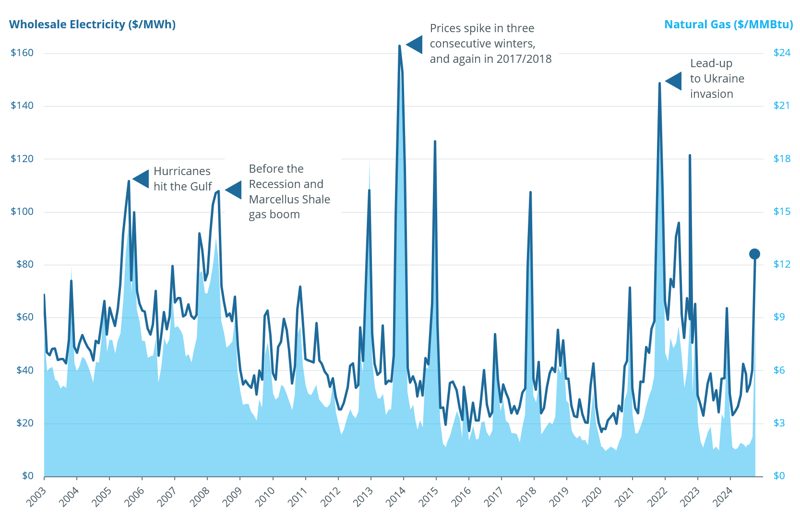 Natural gas is the predominant fuel in New England. This graph demonstrates the link between wholesale electricity price spikes and natural gas price spikes. Source: Markets, ISO New England.
Natural gas prices are subject to disruptions in weather, trading, and geopolitics. When gas sets the price of electricity—which is often the case—the market inherits those risks. The events of the past couple of weeks have demonstrated as much. Since the U.S. and Israel’s attack on Iran, oil and gas prices have skyrocketed. With New England’s reliance on natural gas, global price spikes translate to higher energy bills here in our region.
Adding more renewable energy to the generation stack means reducing our exposure to gas price volatility. For instance, this winter, gas prices soared during evening peaks and winter storms. Fortunately, those moments are when offshore wind is at its strongest and, therefore, delivers the most benefits.
Unfortunately, the Trump administration's stop-work order on five under-construction offshore wind projects has the potential to cost ratepayers an additional $45 billion over the next 10 years if they were not to become operational. This, in part, is why Green Energy Consumers joined a national coalition of wind and solar organizations in a lawsuit against the Trump administration’s attempts to forestall wind and solar development across the country.
Like offshore wind, behind-the-meter (BTM) solar—solar panels installed on, and directly connected to, the property of the energy consumer (i.e. rooftop solar)—exerts downward pressure on wholesale electricity prices. However, instead of adding more supply to the grid, BTM solar reduces overall energy demand by feeding electricity directly to the user. By lowering demand on the grid, BTM solar reduces the need to call on more expensive power plants. This effectively lowers the clearing price of electricity for the entire wholesale market.
Synapse Energy Economics estimated that between 2014 and 2019, BTM solar reduced wholesale energy market costs in New England by $1.1 billion. Another report from the Acadia Center found that on the highest-peak day of 2025, behind-the-meter solar met around 22% of system load, translating to more than 5,000 MW of distributed solar generation. This had the combined benefit of suppressing demand, preventing blackouts, and saving customers collectively between $8.2 million and potentially $19.4 million in energy costs.
Overall, bringing renewables online stabilizes the clearing price against volatile oil and gas prices, which leads to significant cost savings for ratepayers.
Comments