
.jpg?width=30&name=larry%20(1).jpg)

In the Bay State, the legislature is grappling with the question of how much to spend on the efficiency program known as Mass Save. This blog is mostly about that debate and how it affects about 20 percent of the homes in Massachusetts heated by oil, but the basic point being made here applies equally to the other New England states: state energy efficiency programs are our best defense against the harsh and frequent vicissitudes that plague the oil market.
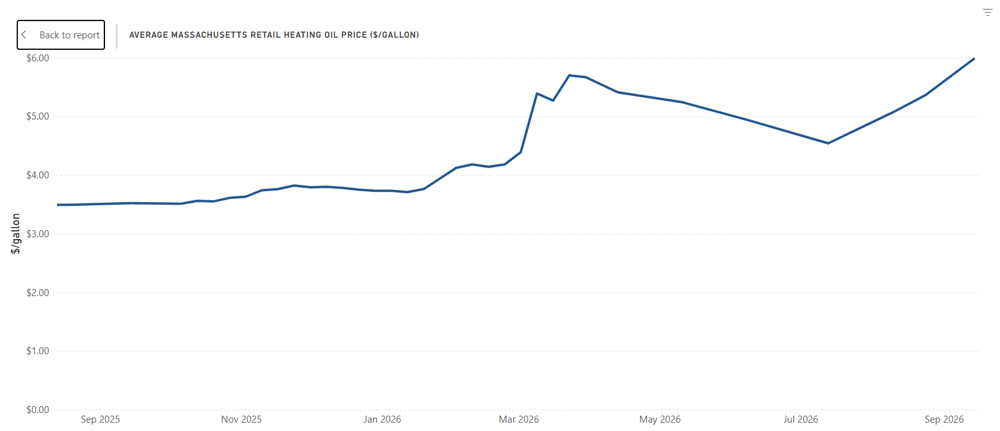
If you received an oil delivery in recent weeks, you have some idea as to how fuel prices are rising as a result of the two wars going on. But since you don’t get deliveries often from April through November, you might not realize that the trend is getting far worse. As of September 14, the average retail price of heating oil in Massachusetts is $5.98. That compares to $3.52 from a year ago. It’s an increase of 70 percent. The price has risen by a dollar since mid-July.
What is the alternative to heating oil?
Last year, the Mass. Department of Energy Resources posted this graphic in advance of the 2025/2026 heating season to show the relative costs of various heating options.
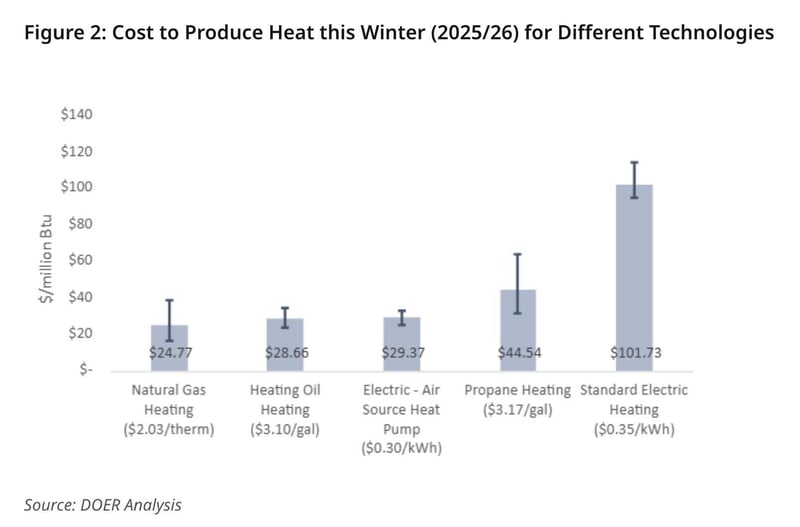
The graphic shows that, under last year’s assumption of $3.10 per gallon for heating oil, the cost per Btu was about the same for heating oil and heat pumps. But note that the actual cost per gallon for the 2025/2026 heating season was 25% higher at $4.09 per gallon. So much for the forecast. In fairness, forecasting is hard, especially when wars come into play.
Heat Pump Rates
There is another important missing piece from last year’s comparison chart. The cost per kilowatt-hour (kWh) used for heat pumps in the graphic does not include the lower seasonal base distribution heat pump rates that went into effect on November 1, 2025, for Massachusetts heat pump customers of National Grid, Eversource, and Unitil. This lower rate applies to the ratepayer’s whole electricity bill from November 1 through April 30 if they have a heat pump. So, it also reduces the cost of running electric water heaters, clothes dryers, dishwashers, refrigerators, EVs, etc. When you factor all that in, clearly, heating oil customers paid a lot more last winter for warmth than people with heat pumps. The heat pump rates resulted in about $368 in savings per heat pump customer last year. You can sign up for our upcoming webinar to learn more about the savings from heat pump rates here.
2025-2026 Wintertime Heat Pump Rates
| Utility | Winter heat pump distribution rate | Approx. winter savings |
| Eversource | 2.052 cents/kWh, plus a 1.492 cents/kWh transmission rate | 7.0 cents/kWh |
| National Grid | 2.440 cents/kWh | 4.15 cents/kWh |
| Unitil | 3.633 cents/kWh | 6.0 cents/kWh |

What about this year’s heating costs?
The Mass. Department of Energy Resources has not yet produced a similar heating options graphic for this year, but let’s apply some critical thinking. If you have not needed a delivery of heating oil recently, a good proxy to watch is the price of diesel fuel that you can see at any filling station. Diesel and heating oil are the same product. The price of diesel is higher because it is taxed. Oil industry experts are seeing what’s happening with oil production and refining from the Persian Gulf and Russia, and they are expecting even higher prices for diesel and heating oil in the weeks ahead.

As a result of the wars, heating oil consumers are being hurt by several factors.
-
Crude oil prices are rising because production is low coming out of the Strait of Hormuz and a nearby pipeline that will be closed for about six more weeks, according to Bloomberg News.
-
Refinery capacity for diesel fuel is limited because of damage done by both wars. The difference between gasoline and diesel prices shows that.
-
Trucks that deliver oil to homes and businesses run on – you guess it – diesel. For that reason, the cost of delivering the oil has gone up.
-
Interest rates are rising, making it more expensive for heating oil dealers to finance the lag between when they buy oil from wholesalers and when they get paid by their customers.
What all this means is that, at least while the wars rage on, we cannot expect heating oil prices to fall back to affordability.
-1.png?width=800&height=533&name=chart%20(1)-1.png)
New England's stocks of distillate fuel oil (or diesel and heating oil) are around the lowest on record heading into the fall.
Granted, electricity rates are ticking upwards (largely because of the wars creating volatile fuel prices for power plants), and that raises the cost of running a heat pump. But electricity rates have not doubled in price from last year like heating oil prices have (compare last year’s DOER assumption of $3.10 per gallon to this year’s current average of $5.98). And again, the seasonal heat pump rate lowers electricity prices for running a heat pump.
Note: National Grid and Unitil heat pump users will see an even lower electricity price this year, as those utilities are now incorporating an adjusted transmission rate in addition to the lower distribution rate, like Eversource already did last heating season.
Where Mass Save Comes In
 Without question, Mass Save is the biggest lever that policymakers have to reduce the Commonwealth’s consumption of incredibly expensive and dirty heating oil. Mass Save is the program that funds energy assessments, air sealing, insulation, heat pumps, and heat pump water heaters.
When the Mass Save program for 2025-2027 was approved by the Department of Public Utilities (DPU), they assumed heating oil prices of about $3.10/gallon to calculate the benefit-cost ratio of program investments. Now that heating oil prices have nearly doubled, if we redid the same benefit-cost ratio calculation, the benefits of every dollar invested in Mass Save would far exceed what the DPU calculated back when it approved the plan. We are getting a better-than-expected return on our investment!
As you read this, there is a conference committee of members from the Massachusetts House and Senate working to reconcile differences between energy affordability bills that each chamber passed – the House in February and the Senate in June. A major point of contention is what to do about Mass Save. The House bill would cut $1 billion from the 2027 Mass Save budget of about $1.5 billion. The Senate bill included no such cut.
Given the price of heating oil and world events, does a one billion dollar cut to Mass Save make sense to you?
To protect consumers from energy price spikes, we should be investing more in efficiency and electrification, not pulling back.
|
Rhode Island The same logic applies across the border in Rhode Island. More than one-third of Rhode Islanders rely on delivered fuels for heating. While Rhode Island does not have a heat pump rate in effect yet (we’re working on it!), heating oil is one of the most expensive heating options. And yet, the governor attempted to roll back the very energy efficiency programs that reduce people’s need to utilize volatile fuel oil while also making the transition to efficient heat pumps easier. Fortunately, the legislature did not adopt the governor’s proposed efficiency rollback. |
You still have a role to play.
The legislature formed a conference committee to resolve differences between the energy bills passed by the House and Senate. The committee is made up of three members from the House and three from the Senate. But your senator and representative can still influence the conference committee. So ask your legislators to do just that.
Please call or email your state Representative and Senator (you can find them here).
You could say something like:
“Hello, my name is [NAME], and I live in [TOWN]. I urge you to ask the Energy Conference Committee to reduce gas utility overspending, regulate third-party electric suppliers, and promote clean energy. Most of all, I am also asking you to express strong opposition to cutting Mass Save’s budget. Thank you.”
Comments