


If you’re a current or potential future electric vehicle (EV) driver in Rhode Island, there are some important new changes you should be aware of.
First, Some Bad News: New EV Registration Fees
At the very end of Rhode Island’s 2025 legislative session, the legislature passed, and Governor McKee signed into law a new registration fee for EV drivers. These fees started on January 1, 2026. The fees per vehicle type are outlined below:
- $200 annually for battery electric vehicles
- $100 annually for plug-in hybrid electric vehicles
- $50 annually for hybrid electric vehicles
It’s important to note that while vehicle registration frequency depends on vehicle plate type, most passenger cars register every two years. That means the above fees will be doubled, so a battery (EV) owner can expect to pay $400 to register their car in addition to the standard registration fees.
We strongly oppose these registration fees. They raise the cost to make the switch to an EV at a time when we need to accelerate the rate with which we replace gas cars with EVs, for the climate and our health.
Rhode Island's recently released Climate Action Strategy projects that the state will need to see a 16-fold increase in EV registrations over the next 24 years to reduce emissions as required by the Act on Climate. Making EVs more expensive at the same time – it just makes no sense.
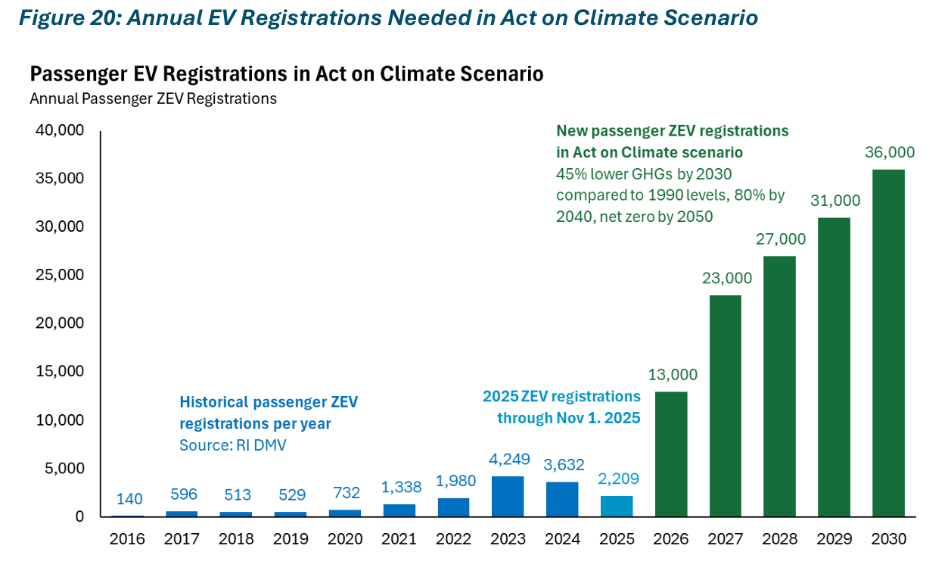
Figure from Rhode Island 2025 Climate Action Strategy p. 68.
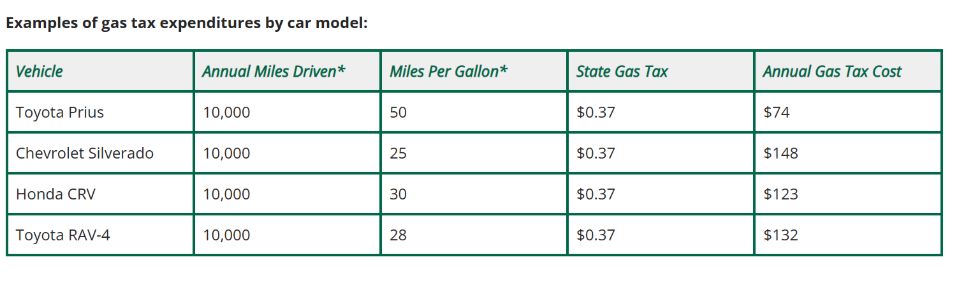
The Governor proposed these fees (p. 22), nominally as a way for the state to recoup lost revenue from EVs not paying into the gas tax. They were subsequently approved by the legislature in the finalized budget (p. 25). These fees are far greater than an owner of a gas-powered vehicle (even a relatively inefficient pickup truck) would be paying annually in the gas tax.
How do other states measure up? Many states have EV-specific registration fees, but only twelve have fees of $200+ for battery EVs. The same goes for plug-in hybrid electric vehicles; there are many states with additional registration fees in place, but only seven have fees higher than $100.
Registration fees also charge all EV owners the same amount, regardless of how much they drive. By contrast, the gas tax is assessed on each gallon of gas purchased, so the more someone drives (and the more wear and tear they cause) the more they pay into the tax.
All this is occurring at a time when the federal government has withdrawn the $7,500 tax credit for EVs. This resulted in significantly lower EV sales in November of 2025 as compared with that time in 2024, and moving into 2026, the BloombergNEF report is projecting that 2026 will see a 15% reduction in EV sales.
This means a 15% reduction in EV sales even without this increase in registration fees. Simply put, Rhode Island is backtracking on climate progress and taking steps to impede the adoption of critical, low-or no-emissions vehicles.
The Good News: Increases to EV Rebates!
For some good news, the Rhode Island Office of Energy Resources (OER) recently increased state rebates for electric vehicles!
DRIVE EV Rebate Program
Rhode Island residents can now save more with state incentives on the purchase or lease of a new or used battery electric vehicle (BEV) and plug-in hybrid (PHEV). The statewide rebate program, called DRIVE EV, recently increased rebate amounts for its standard new or used and income-qualifying rebates. RI residents can access these savings on qualified EV purchases on or after January 5, 2026. The program changes are described below.
Standard DRIVE EV Rebate Amounts
|
For New EVs |
For Used EVs |
|
$3,000 for new BEVs or $2,000 for new PHEVs with a maximum purchase price of $75,000 *Before the new year, this rebate was $2,000 for BEVs and $1,500 for PHEVs with a maximum purchase price of $60,000. |
$2,500 for used BEVs or $1,750 for used PHEVs with a maximum purchase price of $55,000 *Before the new year, this rebate was $1,000 for BEVs and $750 for PHEVs with a maximum purchase price of $40,000. |
See here for more information about DRIVE EV program eligibility requirements.
DRIVE+ (Income-Qualifying Rebate Adder) Rebate Amounts
|
For New EVs |
For Used EVs |
|
$1,500 for new BEVs or $1,000 for new PHEVs *This rebate remains the same. |
$1,500 for used BEVs or $750 for used PHEVs *This rebate remains the same. |
Total Possible Savings with DRIVE EV and DRIVE+
|
EV Type (BEV or PHEV) |
DRIVE EV Rebate |
DRIVE+ Rebate |
Total Savings |
|
New BEV |
$3,000 |
$1,500 |
$4,500 |
|
New PHEV |
$2,000 |
$1,000 |
$3,000 |
|
Used BEV |
$2,500 |
$1,500 |
$4,000 |
|
Used PHEV |
$1,750 |
$750 |
$2,500 |
See here for more information about DRIVE+ program eligibility requirements.
PowerUp RI
Rhode Island homeowners and landlords can now save more through the state PowerUp RI incentive program for the purchase and installation of a Level 2 EV charger for their home.
PowerUp RI Rebate Amounts
|
Type of Rebate |
Electrical Upgrade |
Rebate Amount |
Costs Covered |
|
Standard |
No Upgrade Needed |
100% up to $800 *Before the new year, this rebate was 50% of the purchase price, up to $350. |
Purchase Price |
|
Upgrade Needed |
50% up to $1,000 *Before the new year, this rebate was 50% of the purchase price and installation costs, up to $700. |
Installation Costs |
|
|
Income-Qualified |
No Upgrade Needed |
100% up to $800 *Before the new year, this rebate was 75% of the purchase price, up to $500. |
Purchase Price |
|
Upgrade Needed |
75% up to $1,500 *Before the new year, this rebate was 75% of the purchase price and installation costs, up to $1,000. |
Installation Costs |
See here for more information about PowerUpRI eligibility requirements.
Bottom Line
If you’re planning on getting an EV in Rhode Island, you’ll pay a higher registration fee, but you’ll get a larger rebate.
Comments