
.jpg?width=30&name=larry%20(1).jpg)


For several months, we have seen multiple news reports about the dramatic increase in gasoline and diesel prices at the pump. If you drive a car on gasoline or a truck on diesel, you know that firsthand. But in New England, many homes still heat with oil. Across all New England states, more than one-fifth of households rely on oil to heat their homes, ranging from 22 percent in Massachusetts to 55 percent in Maine. These families are facing a crisis.
Share of households with oil heating in New England states, 2024
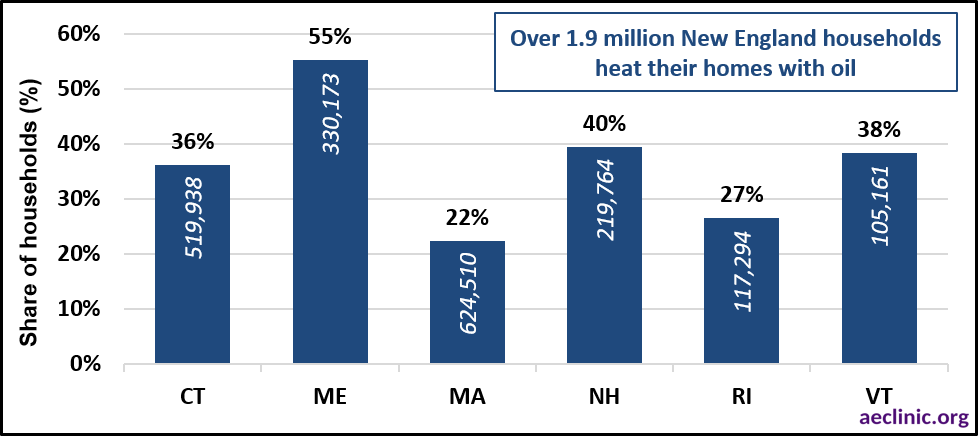
Data source: U.S. Census. 2024. American Community Survey 5-year Estimate (Table B25040).
Recent Months
On October 12, the Mass. Department of Energy Resources reported that the average retail heating oil price was $6.18 per gallon, an increase of six cents over the prior week, and up from $3.53 last year—a 73% increase. Since the middle of January, the average price in Mass. has risen from $3.76, as the graph below shows. Prices in the other New England states have risen similarly.
Average Massachusetts Retail Heating Oil Price ($/gallon)
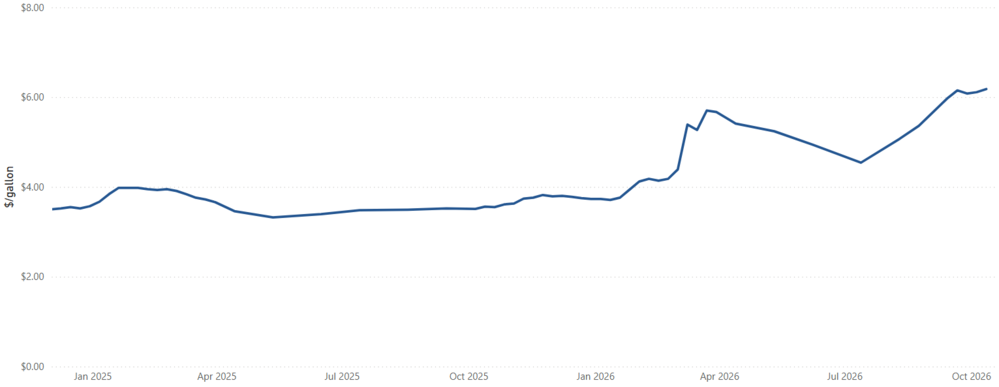
Data Source: Mass. Retail Heating Oil and Propane Prices - Dashboard
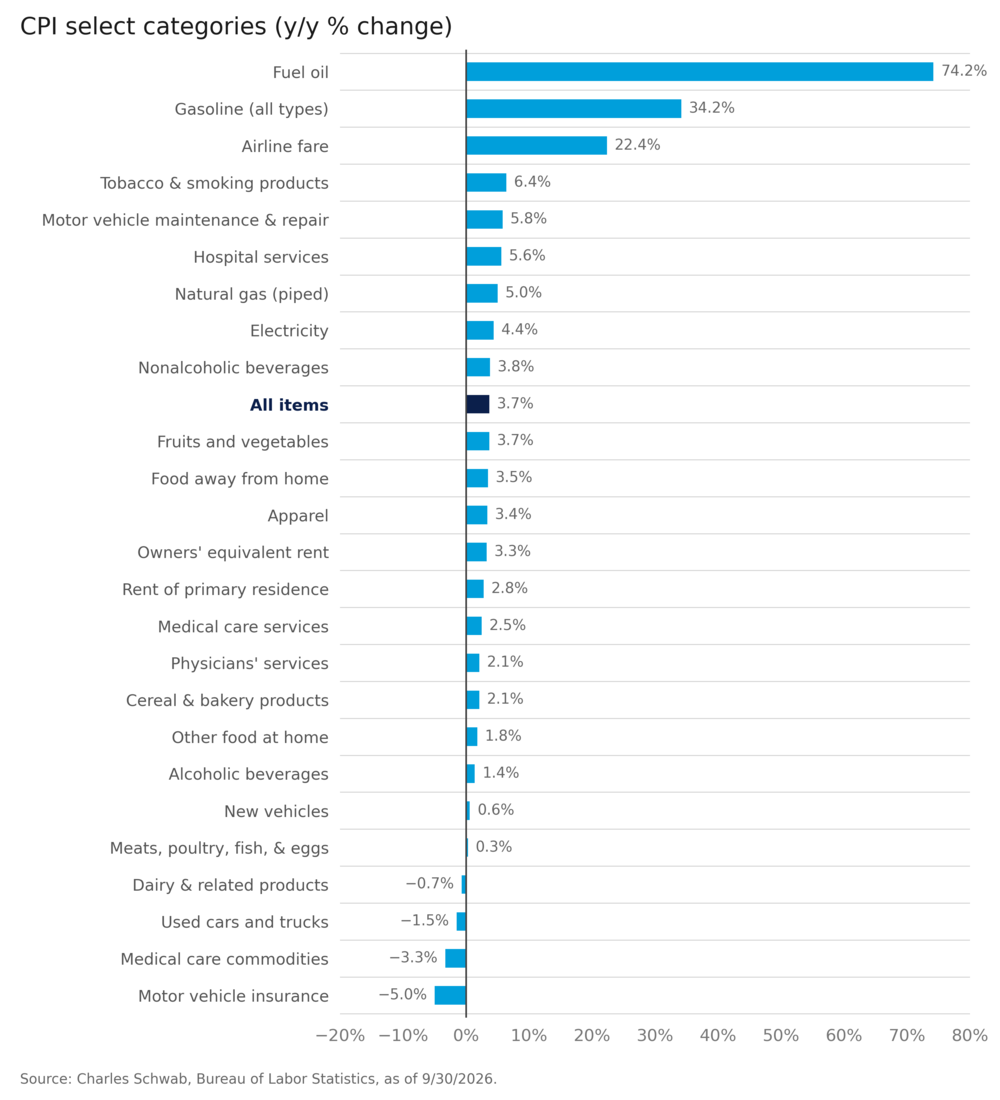
The graphic below shows how extraordinary fuel oil inflation has been in the last year. It shows how much individual components have contributed to the Consumer Price Index, the most commonly used indicator of inflation.
The Federal Forecast, For What It's Worth
On October 6, the federal Energy Information Administration released its annual Winter Fuels Outlook. EIA expects heating oil prices nationwide to decline each month from now through March, based on its assumption that oil will begin to flow through the Strait of Hormuz. We believe this outlook is overly optimistic and out of step with current market realities. The wars between Russia and Ukraine and the United States and Iran could continue to cause prices to remain high, and an end to hostilities is unlikely to have a fast impact on global stocks of oil or U.S. domestic oil prices.
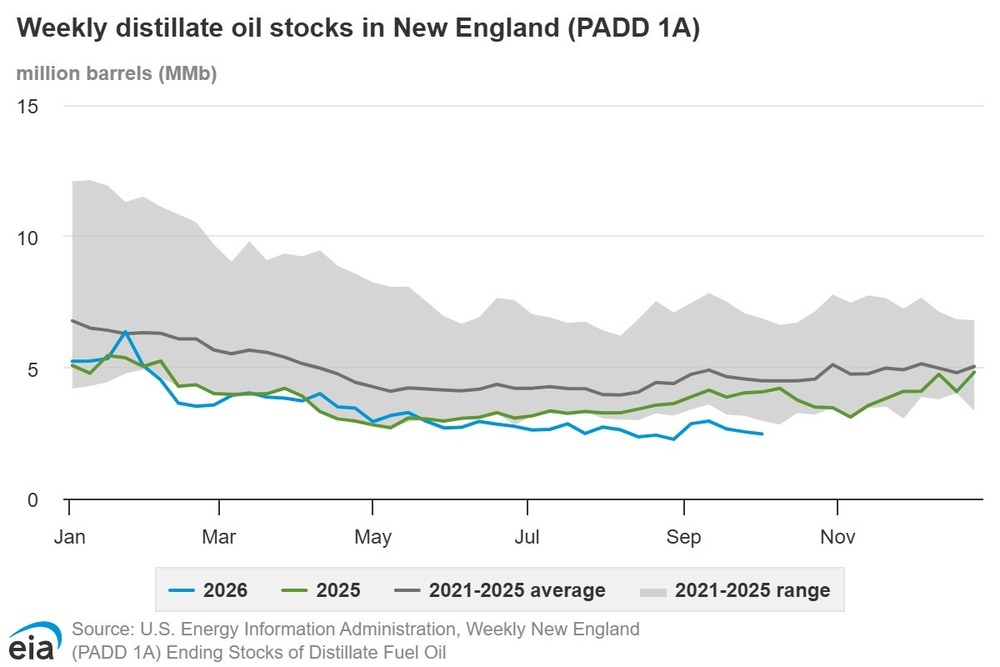
We are also concerned that distillate oil (which includes both diesel and heating oil) inventories in the New England region have fallen to their lowest level in several years. This adds to the potential for even higher prices if supplies are constrained because inventories are not providing much of a buffer.
The following graph is taken from EIA.
We would also note that the cost of shipping crude oil to refineries has risen dramatically in recent weeks, and so refineries will pass that cost onto the products we buy: gasoline, diesel, and heating oil. Even if crude oil production increases, the price of heating oil is unlikely to fall—unless we have a very warm winter. This is yet another reason consumers and policymakers should not accept the EIA forecast.
But even the EIA forecast indicates that heating oil prices will be 34% higher this winter than last. They also forecast warmer temperatures due to the El Niño. When EIA factors in their assumption about heating oil prices and temperatures, they estimate that heating oil consumers in America will spend 21% more than last winter, but they show a large amount of uncertainty.
Whether consumers pay 21% more than last year or twice as much as last year, it’s a crisis. For low-income consumers who cannot afford new equipment, especially in time for the heating season, the obvious response by the federal government should be to increase funding for the Low Income Heating Assistance Program, commonly known as fuel assistance. But states should also supplement that funding to the extent possible.
Home Heating Options
Oil consumers who are able to finance a new heating system should act immediately. If we assume that the average heating oil price this winter stays at $6.18 per gallon as it is now, then the average-sized Massachusetts household heating with oil is expected to spend nearly twice as much on heating as a household using a heat pump. Again, the situation is pretty much the same in the other New England states.
Applied Economics Clinic has produced an analysis, comparing the cost per Btu of heating sources including oil, propane, gas, electric resistance, air-source heat pumps, geothermal, and networked geothermal. Massachusetts households can save around $1,300 per year on heating bills by switching from oil to heat pumps.
Total winter heating costs for an average-sized home in Massachusetts by heating type
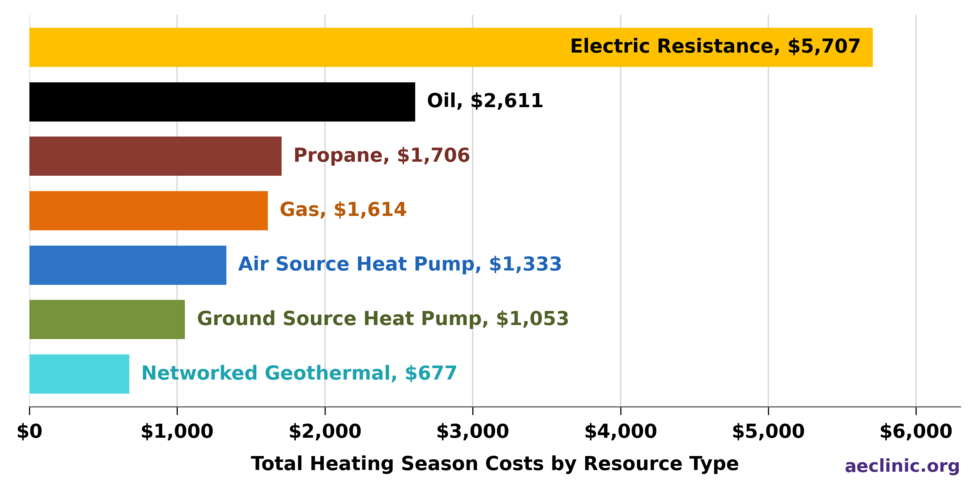
Using AEC's Heating Electrification Assessment Tool (AEC-HEAT), AEC estimated residential heating costs in Massachusetts by resource type based on the annual heating requirement of 50.4 MMBtu for an average-sized New England home and the applicable efficiency rates or coefficients of performance (COPs) for each resource type (see AEC-HEAT's User Guide and Methodology for a more in-depth explanation of calculations and input assumptions). In New England, an average-sized home (1,645 square feet of heated space) requires 50.4 million Btus (abbreviated “MMBtu”) of heat each year, regardless of the energy source that produces the heat. Source: U.S. Energy Information Administration (EIA). June 2023. 2020 Residential Energy Consumption Survey (RECS) Data [Table CE3.2].
Electric rates: (1) Massachusetts Department of Public Utilities. Accessed September 30, 2026. "Basic service information and rates."; (2) National Grid. 2026. "Tariff Provisions: Summary of Electric Delivery Service Rates." M.D.P.U. No. 1-26-H and 1-26-I.; (3) Unitil. 2026. "Massachusetts Residential Electric Rates."; (4) Eversource. 2026. "Tariff Provisions: Summary of Electric Delivery Service Rates." M.D.P.U. No. 1-26-F.
Gas rates: (1) Massachusetts DPU Docket No. 26-PGAF-GRID. September 2026. 2026-2027 Peak Gas Adjustment Factors for Boston Gas Company d/b/a National Grid, Effective November 2026. Attachment B. Submitted by Boston Gas Company d/b/a National Grid. pp.1-2; (2) Massachusetts DPU Docket No. 26-PGAF-NSTAR. August 2026. 2026-2027 Local Distribution Adjustment. Section V. Submitted by NSTAR Gas Company d/b/a Eversource Energy. p.3; (3) Massachusetts DPU Docket No. 26-PGAF-EGMA. August 2026. 2026-2027 Local Distribution Adjustment. Section 14A. Exhibit EGMA-MQ-2. Submitted by Eversource Gas Company of Massachusetts d/b/a Eversource Energy. p.3;
Heating oil and propane retail prices: Massachusetts Department of Energy Resources (MassDOER). 2026. "Massachusetts Home Heating Fuels Prices."
Need financial assistance, advice, or information about heat pumps?
If you or someone you know is on a limited income, contact your local community action agency. If you are eligible, they can enroll you in fuel assistance, a discount rate for electricity or gas service, and hopefully help you get weatherization and a heating system upgrade. Here’s a web page for Massachusetts. For Rhode Island, look here.
If you want to switch to a heat pump, look to Mass Save in the Bay State and Clean Heat Rhode Island in the Ocean State.
Upcoming Webinars
Massachusetts has lower electricity rates for heat pump owners. We’re trying to get Rhode Island to follow suit.
Are you familiar with window heat pumps? They’re a cost-effective heating solution that is an excellent solution for many renters. Register for our webinar on November 3 to learn more about window heat pumps and other emerging technologies.

Final Note
It would be nice if our national government supported the transition from fossil fuels to clean heat. Here’s one country that does.
Dr. Elizabeth A. Stanton is the founder and executive director of the Applied Economics Clinic. Dr. Stanton has an extensive publication record, including more than 200 reports, journal articles, books and book chapters, as well as over 60 expert comments and oral and written testimony in public proceedings on topics related to energy, the economy, the environment, and equity. Amanda Barker is the Clean Energy Program Director at Green Energy Consumers. Larry Chretien is the executive director.
Comments