

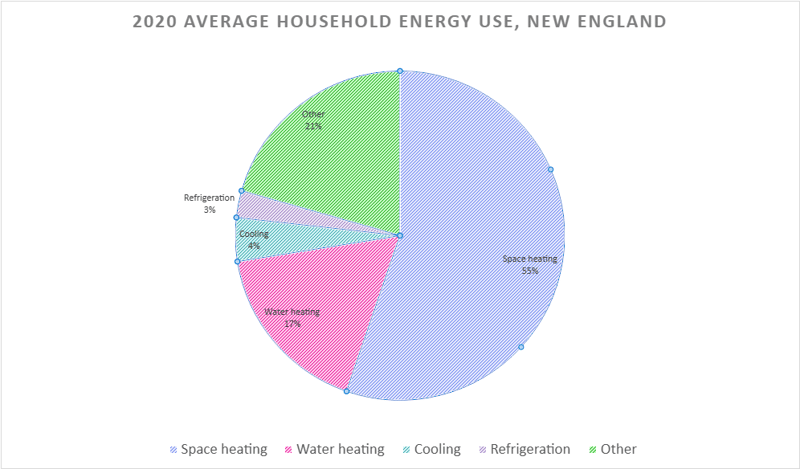
In the fight against climate change, figuring out efficient and clean ways to heat water for showers, laundry, and dishwashing is a crucial part of reducing emissions. For the average New England household, domestic water heating accounts for 17% of the home’s annual energy usage. Replacing water heaters is also one of the most frequent and costly maintenance tasks that many property owners and landlords must face. Most hot water storage tanks last about 10 years, meaning that property owners might replace their water heating systems two or three times more frequently than their furnaces or boilers. This makes water heater conversions an important opportunity for cutting our region’s carbon footprint.
U.S. Energy Information Administration - EIA - Independent Statistics and Analysis
What is a Heat Pump Water Heater?
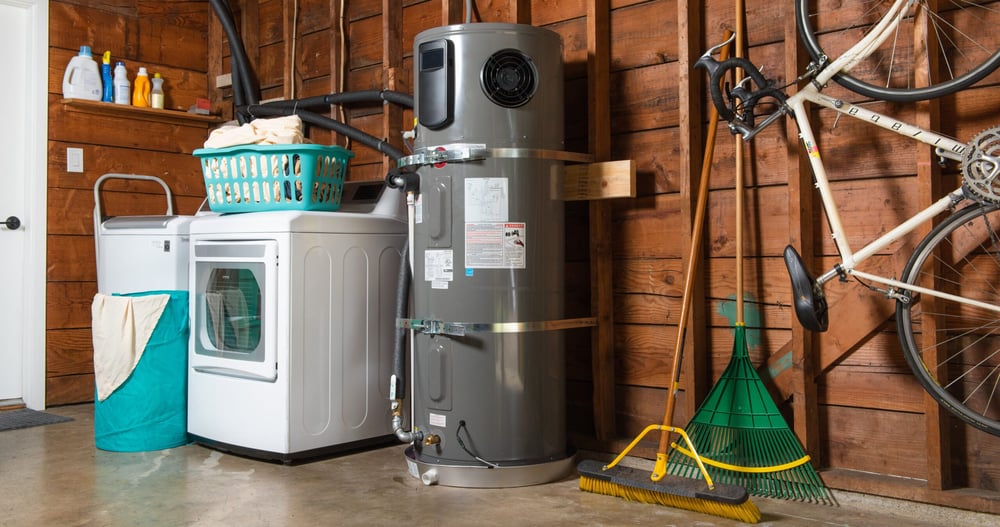
Heat pump water heaters are always less polluting options compared to any other type of water heater. A heat pump water heater (HPWH) is super-efficient because it uses a highly temperature-sensitive refrigerant to absorb heat from your basement, concentrate that heat to a high temperature, and then distribute that heat into water in a storage tank. Because it is not combusting gas, oil, or propane, no waste heat goes up your chimney, nor is there any release of CO2 or other harmful gases.
Operating Costs
Even compared with conventional electric resistance tanks, HPWHs are the greener and less expensive choice. While an electric resistance tank might need 4500 watts to heat water, a comparably sized HPWH needs only 700 watts. For this reason, the grid-related pollution and the operating cost for a HPWH are always going to be much less than for an electric resistance tank.
HPWHs are also often less expensive to operate than a gas- or oil-fired water heater. This is especially true if the home is heated by heat pumps, as the new seasonal heat pump electric rate reduces costs for all your electrical use. You can compare operating costs using your own local rates for all the various fuel options with an online calculator such as the Mass Save Residential Water Heater Replacement Calculator or Efficiency Maine’s calculator.
As an example, for an eastern MA family of two using a gas-fired hot water storage tank, Mass Save’s calculator estimates the cost for water heating in 2026 will be more than $360. A home with a heat pump water heater is expected to pay less than $300 for its hot water. And a home that qualifies for the new heat pump discounted electric rate would pay less than $225. An oil-fired indirect tank would be very comparable to a HPWH without the heat pump rate, but with the heat pump rate (that is, if the home also used a heat pump system for space heating), the HPWH would save more than $65 compared to the oil-indirect equipment. This is great news for heating oil consumers with indirect water heating who are considering switching to heat pumps.
Cost of water heating without heat pump rate (2-family, eastern MA):
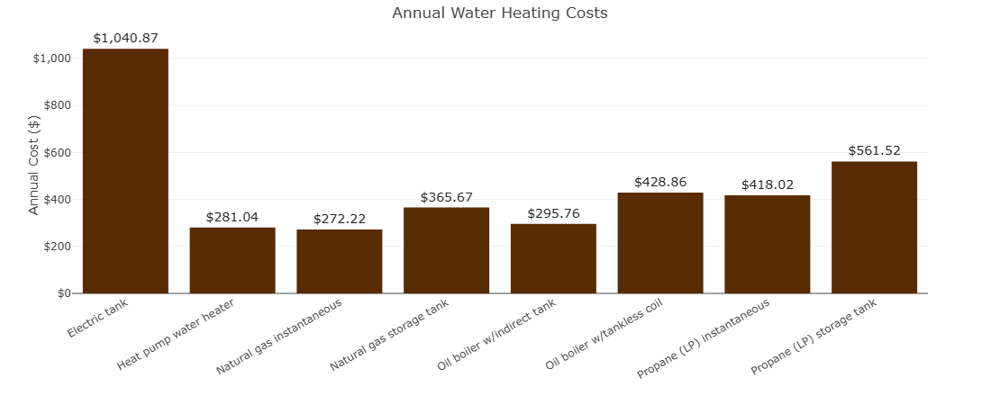
Assumptions: electric rate 35 cents/kWh; gas rate $2.555/therm; oil $3.73/gl; propane $3.59/gl
Cost of water heating with heat pump rate (2-family, eastern MA):
.png?width=1000&height=405&name=newplot%20(2).png)
Assumptions: electric rate 27 cents/kWh; gas rate $2.555/therm; oil $3.73/gl; propane $3.59/gl
We expect the comparison would yield similar results for customers of Eversource, National Grid, and Unitil throughout Massachusetts. The comparable costs in Rhode Island this winter indicate that both oil-fired indirect and gas-fired storage tank options would be more expensive to operate than a HPWH.
Cost of water heating (2-family, Rhode Island Energy customer):
.png?width=1000&height=405&name=newplot%20(1).png)
Assumptions: electric rate 33 cents/kWh; gas rate $2.295/therm; oil $3.59/gl; propane $3.51/gl; Source for all 3 charts above: Mass Save Residential Water Heater Replacement Calculator.
Finding An Installer & Getting A Rebate
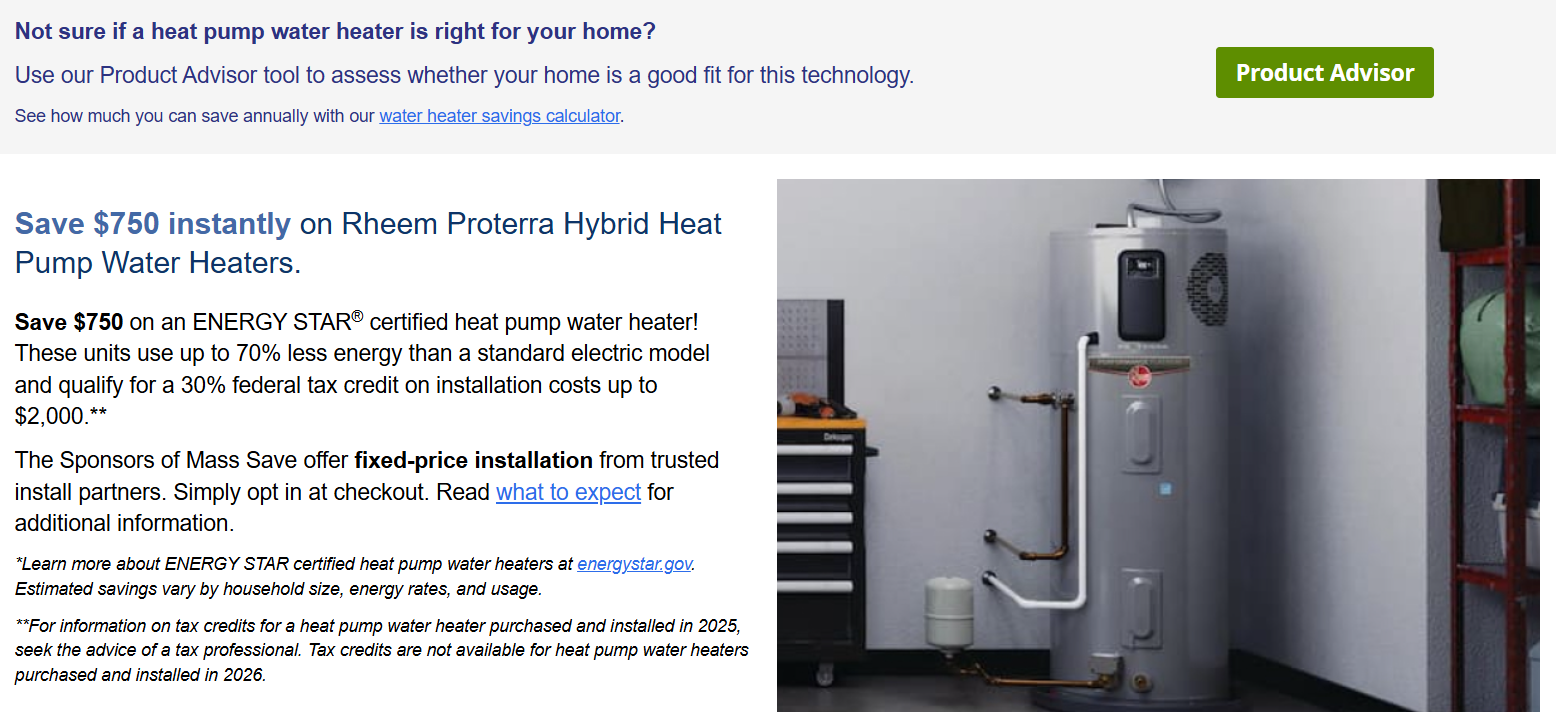
The installation cost for HPWHs tends to be a little more expensive than a conventional storage tank, but both Mass Save and Clean Heat Rhode Island offer a $750 instant rebate on HPWHs. The instant rebate will be applied to the purchase of the HPWH, either by your contractor or by yourself, so you don’t need to apply for the rebate after the fact. Some municipal power companies offer rebates, too.
Many property owners think to replace a water heater only in an emergency when a storage tank is leaking all over the basement floor. These unlucky folks are often stuck taking whatever tank their plumber happens to have closest to hand. Even for property owners who plan ahead, finding a plumber familiar with HPWHs hasn’t always been easy. In Massachusetts, Mass Save is helping to simplify that process through its new HPWH marketplace. This site is particularly helpful for households that are replacing an electric resistance water heater, and especially those that already have a sink or other drain in their basement. These households are most likely to qualify for “fixed-price installation from a trusted vendor.”
For those needing to replace an oil, gas, or propane water heater, Mass Save customers can still use the Marketplace to be referred to the Mass Save-vetted installers, but the price will vary depending on the complexity of any electrical wiring and drain work that is needed. In New England, most HPWHs need a 240-volt circuit and a drain for the condensate produced by taking heat out of the air. Other trusted resources for finding potential vendors include Clean Heat Rhode Island, Mass Clean Energy Center, and the Mass Save list for HPWH vendors.
Learn More
- This Old House has produced this 6-minute video showing the conversion of a standard electric water tank with a HPWH.
- We have answers to frequently asked questions about HPWHs on our website.
Comments