

Rhode Island is at a crucial juncture in taking meaningful action to reduce greenhouse gas emissions. The Climate Action Strategy (CAS), which is a plan required of the state under the Act on Climate, is scheduled to be released to the public on Monday, December 15th, and the annual greenhouse gas (GHG) inventory released by the Department of Environmental Management has been updated for 2023. These two reports provide context for where the state’s emissions are and what ought to be done to achieve the 2030 GHG reduction mandate. Prior to the release of the final CAS, the Executive Climate Change Coordinating Council (EC4) – Rhode Island’s interagency organization tasked with coordinating climate change efforts – released a draft executive summary for the Climate Action Strategy which claims that the state will be able to meet the 2030 Act on Climate (AOC) with the current policies RI has on the books, e.g. the Renewable Energy Standard, Advanced Clean Cars II, and Advanced Clean Trucks regulations (currently under litigation), current incentives for electric vehicles and heat pump, etc.
Unfortunately, we do not think that the draft executive summary is compliant with either the letter or the spirit of the Act on Climate because the law mandates that the EC4 “submit to the governor and general assembly an updated plan ... that includes strategies, programs, and actions to meet economy-wide enforceable targets for greenhouse gas emissions reductions”. The law also states that the plan can direct agencies to issue regulations necessary to reduce emissions (R.I. Gen. Laws § 42-6.2-2) but we haven’t seen evidence yet that the plan will take full advantage of its abilities granted by law.
While the draft summary does include strategies and programs that could be implemented to reduce emissions, it does not elaborate about specific actions the state must take to reach the AOC mandates, and it does not direct any state agency to do anything. There only exists a placeholder for “EC4 options for implementation” (Rhode Island 2025 Climate Action Strategy Draft Executive Summary, pg. 2). The emissions reductions attributed to existing policies the state has on the books have not been substantiated with publicly shared data, and the baseline assumption of where Rhode Island’s emissions are projected to be in 2025 are overly optimistic given the state’s failure to implement meaningful policies to reduce emissions in the buildings and transportation sectors (our largest greenhouse gas emitting sectors).
The draft summary lists various strong policies that, if implemented, would reduce emissions. However, the summary does not (as it definitely should) declare which policies are recommended, when they should go into effect, and at what rate they would reduce emissions. If state agencies do not get to work immediately on some of the policies outlined in the Strategy, Rhode Island will likely go another year without making progress on reducing emissions, except for the Renewable Energy Standard mandating increasing amounts of electricity be supplied by renewable resources. In other words, we have little to no confidence in the figures shown in the draft report.
Measuring Progress Towards the Act on Climate
Governor McKee signed the Act on Climate in April 2021 which set mandatory and enforceable emissions reductions mandates.
Emissions must be reduced:
- 45% below 1990 levels by 2030
- 80% below 1990 levels by 2040
- Net zero by 2050
The graph below depicts the states' progress through 2023 towards meeting the benchmarks in the Act on Climate with the blue line charting the path of annual emissions. Data for 2024 and 2025 are not yet publicly available.
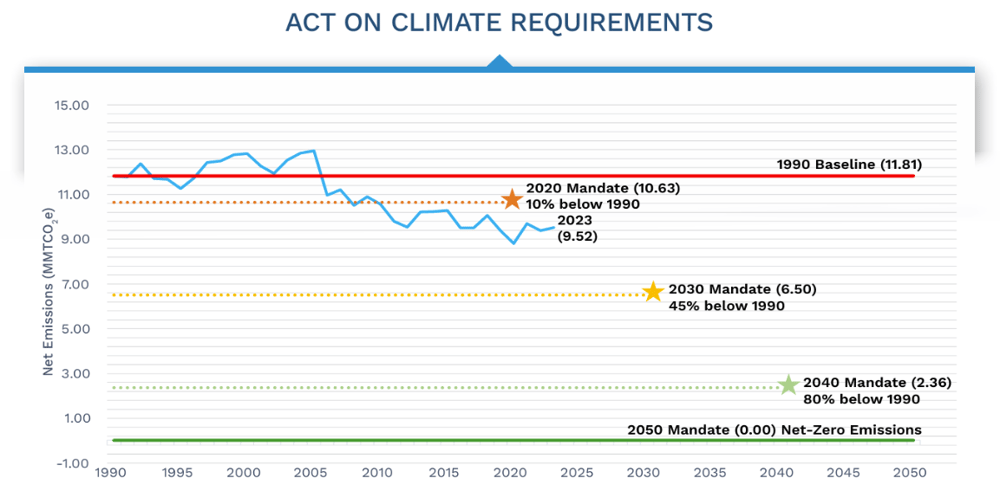
Image from the DEM Greenhouse Gas Inventory, 2023.
Recently, the Department of Environmental Management released the 2023 statewide greenhouse gas (GHG) inventory with the emissions summary depicted below. While overall emissions have declined by 19.5% since 1990, emissions have increased since 2020 (more on that below).
.jpg?width=980&height=757&name=ghg-quick-facts%20(1).jpg)
Statewide Emissions & Progress Towards the Act on Climate
The GHG inventory is critical because it allows us to evaluate the sectors of the economy that emit the most and determine what policies would be effective in curbing and reducing emissions. When evaluating emissions over the past 5 years, emissions have only declined by 5.4%. The inventory report states “a similar rate of decrease between 2024 and 2030 would not allow the state to achieve the Act on Climate’s requirement of 45% below 1990 levels by 2030” (DEM 2023 Greenhouse Gas Inventory, p. 25). Emissions would need to decline approximately 4.5% annually beginning in 2024 to comply with the Act on Climate.
Unfortunately, the state is not on track to reduce emissions by 4.5% annually. Emissions are continuing to rise rather than decline, and the legislature has not passed policies in the past few years that would take steps towards reducing emissions. And state agencies have not issued regulations authorized by the Act on Climate. We continue to face resistance on many policies that the CAS executive summary modeled as “most ambitious” for emissions reductions.
In 2023, the three largest emitting sectors were again transportation, buildings (combined totals for residential, commercial, and industrial buildings), and electricity. Increases were seen in emissions in the transportation sector, and emissions in the electricity sector remained the same. Although the state met 24.2% of electricity consumption with renewable energy, as required by the Renewable Energy Standard (RES), overall emissions remained the same because the regional grid operator that procures energy for the New England electric grid, ISO-NE, procured from more carbon-heavy energy sources than in 2022. This has been an ongoing trend since 2020 and indicates that even with a policy aimed at reducing emissions from electricity, it is not always possible if the non-renewable energy we use is dirtier than the energy consumed in the prior year. Overall, however, the RES has been the state’s most effective climate policy.
Emissions declined in 2023 in the building sector for both residential and commercial buildings. The Greenhouse Gas Inventory attributes this not to policy initiatives, but to the winter weather being milder than the previous year and with tools that reduce energy consumption like energy efficiency and weatherization.
The EC4 is finalizing the 2025 Climate Action Strategy, and what we’ve seen from the modeling shared during public engagement sessions is that they are predicting the state’s emissions will be approximately 8.4 MMT in 2025, a drop of 1.12 from the 9.52 MMT that the state emitted in 2023. In the graph below, the black line depicts the state’s estimated net emissions from 2025-2050.
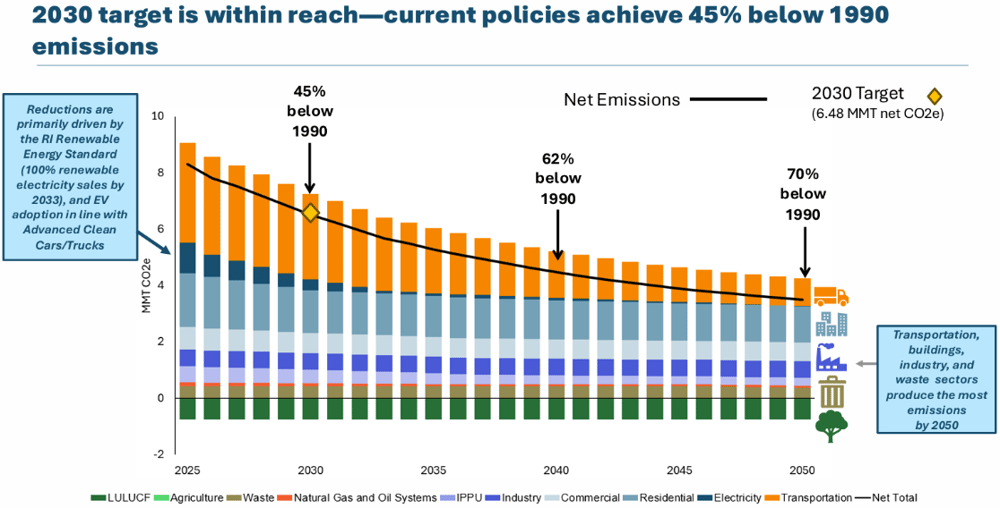
Image from the presentation by E3 at the September 15th EC4 meeting.
We feel that the assumption that the state’s emissions will be 8.4 MMT in 2025 is not credible. The state has not put any policies in place that would drive emissions down approximately 12% over the past 2 years. That is important because the current modeling for the Climate Action Strategy is asserting that the state can meet the 2030 Act on Climate mandate of 45% emissions reductions below 1990 levels, starting with an assumption that between 2023-2025 the state was able to reduce its emissions by 5.8% annually – a larger reduction than the five years between 2019-2023 combined.
Rhode Island Needs to Take Strong Action
We know that Rhode Island must take strong action to implement policies that will reduce emissions at a significant pace. We need policies that will reduce emissions at least 4.5% annually. While there are competing interests for state funding, climate is one issue that affects all residents throughout the state, and policies that reduce emissions can increase equity, improve public health, and reduce utility bills. Below are a few policies that we have advocated for in the past and will continue to advocate for as they can move the needle on reducing emissions.
Building Benchmarking & Performance Standards: Benchmarking energy usage allows building owners to understand the performance of their facility and measure it against other buildings. Performance standards require improvements in measurable qualities related to a baseline, and can ensure buildings are getting cleaner, more efficient, and healthier for inhabitants.
Clean Heat Standard: A Clean Heat Standard is a type of performance standard that would require sellers of fossil fuels (e.g. propane, heating oil, and natural gas) to deliver an increasing amount of clean heat services to their clients, like installing weatherization or heat pumps.
The table below comes from the draft executive summary of the Climate Action Strategy and outlines policies that would reduce emissions from the building sector, along with their associated GHG reduction potential over 25 years. As you can see, many of those policies overlap with ones we have advocated for in the past. The listed policies are also featured in the climate action plans of other states with similar mandates and targets.
The table lists seven policies that have one major thing in common. They are all designed to shift from heating buildings with oil, propane, gas, or electric resistance to high-efficiency, cold-climate heat pump technology.
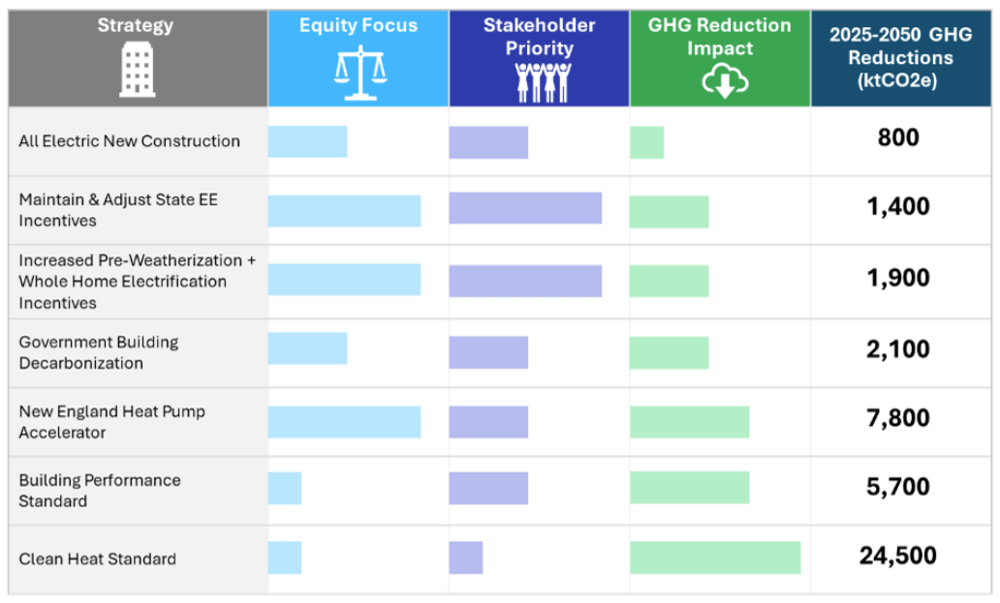
Figure from Climate Action Strategy Executive Summary, pg. 21.
As stated in the 2023 GHG inventory, Rhode Island must move faster on developing policies that would reduce emissions, but the state is running out of time to do so. We hope that after the final Climate Action Strategy is published, the EC4 and all bodies empowered under the Act on Climate will do their part in developing and adhering to policies that would reduce emissions. When the final Climate Action Strategy is published, we will have more to say. Watch this space.
Rhode Island Energy’s New Rate Case
Closely related to the Climate Action Strategy is the fact that Rhode Island Energy (RIE) recently filed several documents with the Public Utilities Commission (PUC) for electric and gas rate increases. RIE is seeking following increases over two years, as reported by Nancy Lavin in the Rhode Island Current. In the first year, the average residential electric customer would see their monthly bills rise $7.78, or 4.83%, and the typical residential gas customer would pay $343.53 more per year, or a 20.6% increase. In year two RIE is requesting another $1.56 added to monthly electric bills, on average, and an increase of $89.43 to annual gas bills. The increases in gas costs can be partially attributed to the rising costs of installing and maintaining equipment on the gas system. Upgrading gas pipelines is about three times more expensive now than it was a few years ago, making the case that RIE should focus investments on the electric system, where demand will continue to rise, and begin curbing investments in a costly gas system that will need to start winding down.
While investments in safety and reliability of our gas and electric systems are important, it is critical to ensure that RIE is not continuing to overinvest in our gas distribution system, through methods like installing new gas mains and line extensions that ratepayers pay for, which will just need to be decommissioned as the state reduces consumption of natural gas to meet the Act on Climate. This is also a reminder that we are still waiting for a final Future of Gas report (Docket No. 22-01-NG) to be released by the PUC, which should include recommendations for how the state would begin reducing gas consumption and unnecessary investments in gas infrastructure. The PUC opened up the Future of Gas investigation in 2022. It is a disservice to the public to delay the final report for this long, given how it could have informed the Climate Action Strategy. We are hopeful that it will be released in time to inform the PUC’s review of Rhode Island Energy’s rate increase.
Make Your Voice Heard at Upcoming Events!
Do you want to offer feedback on the pace of climate action in Rhode Island? Provide public comment or attend a meeting and make your voice heard!
- December 10th: Comments are due on the Climate Action Strategy Executive Summary. Review the draft executive summary and provide comments here.
- December 15th: The Climate Action Strategy will be released. Sign up here to receive updates.
- December 19th: The EC4 will hold an engagement session about the plan.
Comments