

In the recent debate over how to reduce Massachusetts's high electricity prices, one area has been mostly overlooked: reforming the Commonwealth’s less useful energy standards. We think this is unfortunate, because a couple of straightforward reforms could cut people’s bills without increasing the state’s greenhouse gas emissions.
Our Many Standards
In a renewable energy portfolio standard (RPS) or clean energy standard (CES), electricity sellers (utilities, aggregators, third-party suppliers) must buy credits from the owners of clean energy power plants (such as wind and solar farms). This requirement acts as a subsidy to clean energy power plants, paid for by electricity sellers, and through them, their electricity customers. These requirements can encourage the development of clean energy generation, which in turn can also reduce emissions and lower bills by suppressing wholesale electricity prices.
We want to be clear; the Renewable Energy Class I Standard (and its equivalent in many states) is an effective, fundamental policy for changing the composition of the electricity grid in the ways that most voters strongly support. But not every standard in Massachusetts has proven itself to be of equal value to Class I.
The number of standards in Massachusetts has steadily increased over time, and today Eversource, Unitil, and National Grid ratepayers are impacted by what amounts to eight different portfolio standards. There are the Renewable Energy Standard’s Class I, Solar Carve-out II, Class II Renewable, Class II Waste to Energy, the Alternative Energy Portfolio Standard, the Clean Peak Standard, the Clean Energy Standard, and the Clean Energy Standard-Existing.
We support the Class I standard because it helps drive wind and solar development for projects built after 1997. The Clean Peak Standard is also effective at supporting new battery energy storage systems. Those should be kept in place. But some of the other standards deserve a renewed level of scrutiny
For a standard to be effective, they need to do two things:
- Support technologies that reduce emissions
- Make an impact on the amount of clean energy generation that is either built or kept online
While many of the Commonwealth’s standards are useful by these metrics, several are not, and shrinking or eliminating them could provide the legislature with a pathway to reduce bills without compromising the state’s push for more clean energy.
We’ve already written about the issues with the Alternative Energy Portfolio Standard, and now we would like to question the justification of the Clean Energy Standard Existing.
The Clean Energy Standard Existing (CES-E)
While most of the state’s standards were created by the legislature, the Clean Energy Standard was created by regulation by the Mass. Department of Environmental Protection. The Clean Energy Standard requires two types of credits: CES credits, which largely overlap with Class I Renewable Energy Credits (which mostly support new wind and solar), and CES-E credits, which can be earned by hydroelectric and nuclear facilities built before 2011.
As of 2023, CES-E credits were roughly evenly split between New England nuclear plants and Canadian hydroelectric plants, with less than 0.1% going to one Massachusetts hydroelectric plant.
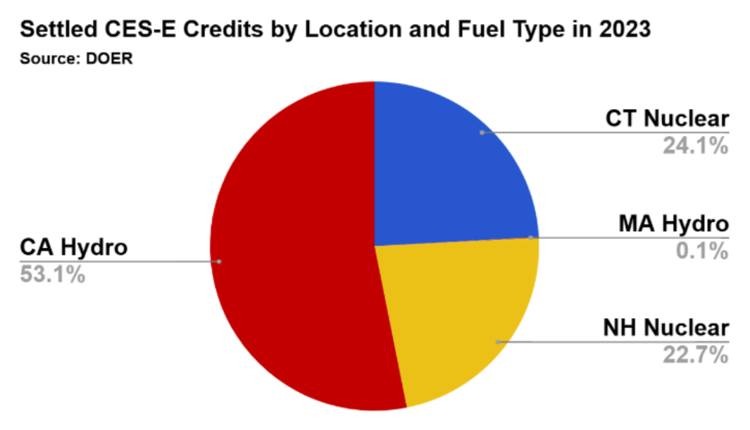 The problem with CES-E, and similar programs like Class II Renewables, is that subsidizing power plants that already exist could result in generation owners receiving payments for operating units that they would have run even in the absence of those payments. If that happens, then the standard hasn’t helped fight climate change or lowered wholesale energy prices; it’s just handed over a large amount of ratepayer money to corporations to no real end.
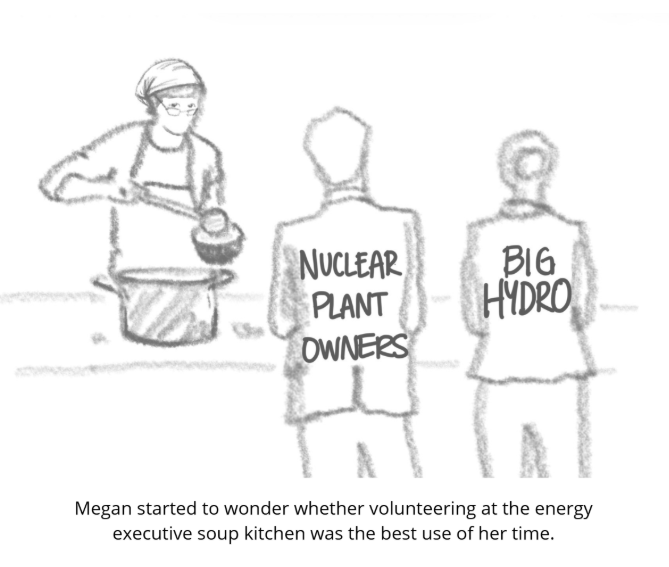
The illustration above was not produced by AI; it was created by our own Becca Miller, Program Associate.
This, and other concerns with the program, were why support for existing units was left out of the original version of the Clean Energy Standard and why a number of environmentalist groups, such as ELM, Acadia Center, Sierra Club, and the Conservation Law Foundation, opposed the creation of the CES-E program.
Rather than the current system of giving untargeted aid, the Legislature could eliminate the program and replace it with a more targeted program, one that would require generation owners to demonstrate they need the support to get it. New York already has similar programs, and Massachusetts could follow suit.
Based on the current cost of CES-E credits, eliminating the program would save electric customers just over $100 million per year or $1 billion over the next decade. That would be the same savings the House wants to achieve through their proposed cut to Mass Save, but wouldn’t require cutting back on helping residents afford insulation, heat pumps, or other energy efficiency measures, or put at risk the jobs of many of the more than 76,000 people who work in the state’s energy efficiency and clean heating industry, as those cuts would.
The Class II Standard for Projects built before 1998
Many of the same issues with CES-E also impact the Class II Renewables program, which supports clean energy power plants built before 1998, meaning mostly small, very old hydroelectric plants and landfill gas projects, many of which are out-of-state. Like CES-E, the program distributes funds to generation owners without checking that those power plants need the support to remain open. Again, we support standards when they cause the renewable energy portion of our power mix to grow, not just stay the same.
As the Senate works on its energy affordability bill, we hope it will target cuts to those programs that aren’t helpful in our efforts to transition away from fossil fuels. There are opportunities in front of the Commonwealth; we just need to grab them.
Comments