
.jpg?width=30&name=larry%20(1).jpg)
It sure seems like a few politicians these days are waving a banner saying, “I’m for all of the above when it comes to energy."
Here is my response to them: We already have all of the above, and it hasn’t been serving us well.
Why are they saying it?
There’s no question – energy prices have risen, along with everything else – eggs, lumber, you name it. As a result, voters are demanding answers from their elected officials. But since energy has become one of our most polarizing issues in American society, politicians are looking for safe bets.
Let’s take a brief pause here to recognize why energy has become so polarized. Ever since the 2010 Supreme Court decision Citizens United vs. the Federal Election Commission, fossil fuel interests have poisoned the well with disinformation about wind power, solar, efficiency, electric vehicles (EVs), and anything else that doesn’t burn oil, gas, or coal. Donald Trump has spread that disinformation from the White House – and so have most Republicans in Washington. Democrats from fossil fuel-producing states often join in.
The beat goes on, and while many Americans understand that our reliance on fossil fuels creates not only environmental and public health harm but also increases cost pressures, many others are susceptible to the misinformation about energy options because of the real harm that has come to their household finances.
2026 is the year of “energy affordability” and “all of the above.”
Here at Green Energy Consumers Alliance, we have been trying to explain that energy inflation is coming primarily from our overdependence upon natural gas, rising gas and electricity infrastructure spending, tariffs, damn cold weather this past winter, and – oh yes – a war on Iran that has closed the Strait of Hormuz. And that energy efficiency, offshore wind, and other clean energy strategies bring down energy costs for all consumers.
Nonetheless, clean energy continues to be a target, not just in Washington, but at the State Houses in Rhode Island and Massachusetts. Politicians who ran on clean energy just four years ago are now saying that to tame costs, “everything must be on the table,” and we need “all of the above” resources.
We already have "all of the above."
Let’s start with electricity, which has been a focal point because we all use it. The graph below shows the resources that powered New England in 2025.
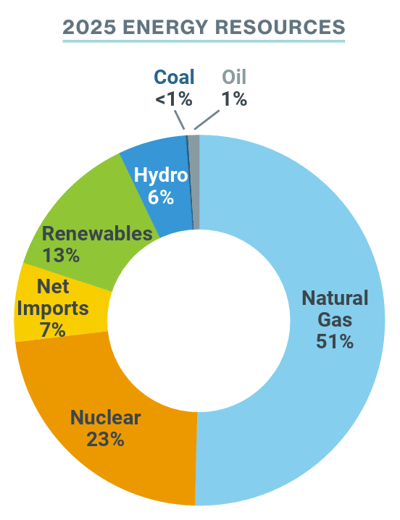
Pretty much covers the spectrum, doesn’t it? Does it look like too much wind and solar to you? For context, gas-fired power was just 40% of the mix in 2020. New England has become heavily dependent on methane, and the gas companies want to double down with support from federal and state governments.
Now look at how Massachusetts and Rhode Island stay warm in the winter. About half the homes and most businesses heat with natural gas (methane). Another 25-30 percent heat with heating oil or propane. And about 20 percent heat with electricity – either old-fashioned, inefficient resistance heat or newer high-efficiency heat pumps. What does “all of the above” mean in this case? When energy efficiency is on the chopping block in Massachusetts and Rhode Island, is “all of the above” code for more fossil fuel?
And last but not least – transportation, which is responsible for more emissions than either buildings or electricity. ISO-New England, the region’s electricity system operator, tracks and forecasts the adoption of electric vehicles in order to plan for their impact on the grid. As of 2024, just 1.9 of light-duty vehicles in New England were electric. Medium- and heavy-duty vehicles are not yet at 1% electric. Those that are not electric are, of course, almost entirely fueled by gasoline and diesel. Maybe “all of the above” means horses and skateboards.
It’s a phrase we can do without.
My guess is that “all of the above” comes highly recommended by political consultants. After all, what could be less offensive? But it implies that the messenger would like to adopt a course correction, as if we have been going off course in our journey away from fossil fuels. Its use without specifics does the public discourse harm. We have a climate crisis. We have an economy in which gas utilities, electric utilities, oil companies, and gas companies are making money hand over fist while ordinary folks struggle to pay their energy bills. So, it is not too much to ask of the people we elect to remember what they campaigned on a few years ago and to acknowledge the facts laid before them. Facts that support a sustained, orderly transition to affordable, clean energy.
As John Kennedy said, “to govern is to choose.”
Comments