

Some electric vehicle (EV) owners in Massachusetts with eligible vehicles will soon be able to receive compensation for plugging in their EVs and sending electricity back to the grid. The process of sending electricity back to the grid from your EV, also known as Vehicle-to-Grid (V2G), can help EV drivers earn extra money from their vehicles while reducing stress on the grid during peak energy demand days. This V2G opportunity will be administered through electric utility companies National Grid and Eversource through their ConnectedSolutions program.
This blog will go over what V2G is and how it works, what the ConnectedSolutions program entails, and how EV drivers can find out if they are eligible and sign up.
What is V2G?
Vehicle-to-Grid (V2G) refers to discharging an EV's battery and sending that electricity back to the grid. In exchange, your utility company will reduce your electric bill or provide additional compensation, depending on the amount of electricity you send back to the grid.
V2G is one example of “bidirectional charging.” Other applications include Vehicle-to-Load (V2L), where electricity from the EV battery is sent to an appliance or device that you directly plug into your EV, or Vehicle-to-Home (V2H), where electricity from the EV battery is sent into the house and can provide back-up power in the event of a power outage. (In this instance, your home is “islanded” from the grid, the same way it would be if you were using a backup diesel generator, so that no electricity flows back onto the grid from your home.)
The image below is taken from a blog that we wrote in 2020. It’s taken some time, but progress on V2G is finally being made.
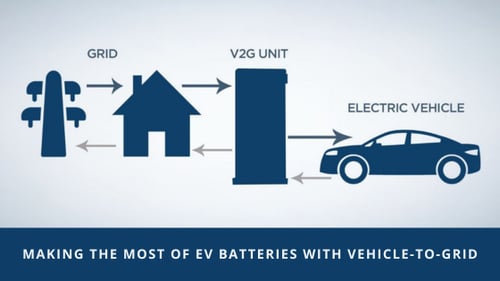
This blog and the program offered by Eversource and National Grid will focus on V2G, since the EV battery will be sending power directly back to the grid. Utility companies are likely to request EVs to discharge their batteries to the grid during days when there is a lot of electric demand, which is where the ConnectedSolutions program comes into play.
What is ConnectedSolutions?
When energy consumption is highest, typically during the hottest days of the year, the electric grid becomes stressed. This is referred to as ‘peak demand,’ which leads to higher energy bills and worse pollution as electricity suppliers turn to dirtier and more expensive fossil fuel plants to keep up with the energy demand during that period. To address this, utilities operate ConnectedSolutions, a demand response program to help reduce strain on the electric grid during peak hours. When a peak event hits, ConnectedSolutions reduces demand on grid power by adjusting the smart thermostats and discharging the batteries that are located in homes and businesses across the state. The existence of this program benefits everyone, not just participants, because reducing demand this way is less expensive and less polluting for the grid as a whole.
Historically, participation in ConnectedSolutions was only available to customers with a smart thermostat or a residential battery system, but the program is now being expanded to include EVs through their V2G program. This V2G program is being made possible through a Massachusetts Clean Energy Center (MassCEC) demonstration project, which means applications will be processed through MassCEC instead of through ConnectedSolutions.
ConnectedSolutions provides annual incentives to homes with enrolled batteries or EVs for allowing your electric utility company to discharge the electricity stored in your battery or EV during periods of peak electricity demand. These events may occur between June and September, generally between 3:00 PM and 8:00 PM, and can last 2 or 3 hours. Your utility company will not call more than 60 events in the summer season. The compensation for enrolling your vehicle in ConnectedSolutions is $275/kW for your vehicle's average contribution during the summer season. You are compensated based on your vehicle’s average discharge across the entire season for each event. If a customer does not choose to participate in an event—whether due to opting out, communication issues, or other performance limitations—that event may be recorded as 0 kW performance, which lowers the season-average incentive.
We recently posted a blog about the ConnectedSolutions program for home battery systems, which has a very similar compensation structure to the V2G program and goes more in-depth on how the events work.
Why is V2G so important?
The increasing availability of V2G programs bodes well for current and prospective EV owners. In addition to the several benefits that are delivered by EVs, such as lower fuel and maintenance costs, lower emissions, and lower adverse public health effects, V2G gives drivers a new way to make money from their cars in a way that is not possible with internal combustion vehicles. The advent of programs, such as this V2G pilot, is vital for the Commonwealth to achieve our vehicle electrification and decarbonization goals.
According to a study conducted by regional grid operator ISO-NE, electricity demand is projected to double by 2050. This same study states that the buildout of transmission infrastructure alone to accommodate this increase in electricity demand could cost New England ratepayers up to $26 billion. Demand response programs like ConnectedSolutions can help us use more of the grid infrastructure that is already built while necessitating fewer costly upgrades by enabling customers with EVs, home batteries, and smart thermostats to reduce peak demand on high usage days. According to the Massachusetts Peak Potential Report, which was created by the Department of Energy Resources (DOER) in 2025 to evaluate different strategies to manage new electric load growth in the Bay State, EV load management through managed charging and V2G programs is a "no-regrets and high potential strategy " to provide short-term and long-term capacity to the grid. What this means is that leveraging EVs is one of the cheapest and fastest ways to support the grid while lowering costs to all customers.
Who's eligible to apply?
To apply to the V2G program, you will need to have a certain type of EV that has both bi-directional charging capabilities and the ability to communicate in terms of software with ConnectedSolutions. To participate in the ConnectedSolutions V2G program, you will need to own or lease (lease end date must be after 12/31/27) one of the following types of EVS:
-
Nissan Leaf (model year 2018, 2023-2025)
-
KIA EV9 (model year 2024-2026)
-
Polestar 3 (model year 2025)
-
Volvo EX90 (model year 2025)
While these are the only EVs that are currently eligible to participate in the ConnectedSolutions, the program administrators are working to increase the number of EVs that will be able to participate through demand response opportunities in the future.
In addition to owning or leasing a vehicle that has bi-directional charging capabilities, you will also need to have an EV charger—commonly known as Electric Vehicle Supply Equipment (EVSE)—that is compatible with bi-directional charging. If your application to the program is accepted, you will receive a bi-directional EVSE that is compatible with your vehicle, along with an on-site assessment and installation of the EVSE, all free of charge. You will also be able to retain full ownership of the installed EVSE at the conclusion of the program.
Finally, you cannot participate in the V2G program if you have solar panels or a battery storage system on the same utility service that you are planning to use to participate in the V2G program.
Enroll now!
Applications for the program are open on a rolling basis while funds are available until September 30, 2026. If you have any additional questions about the program or your eligibility, you can email MassCECV2X@resource-innovations.com.
Comments