

In 2024, third-party “competitive” electric suppliers increased residential electric rates by $80.7 million, according to data from the Energy Information Administration and Massachusetts Department of Public Utilities.
We are reporting here a continuation of a pattern in which retail electricity suppliers who sign up individual customers greatly overcharge them compared to what the customers would pay if they received supply service from either their utility (Eversource, National Grid, or Unitil) or their municipal aggregation if it was available.
These companies did this by signing up residential customers, often by promising to lower their electric bill, and then charging their customers an average of 2.1 cents more per kilowatt-hour (kWh) than customers would have paid had they stayed on either their utilities’ basic service rate or their community’s municipal aggregation program (if it had one).
Given that the average residential customer uses roughly 7,000 kWh per year, this 2.1 cents per kWh premium works out annually to $143 per household.*
This data adds to a long list of documented instances of third-party suppliers increasing average residential rates, including our May 2025 blog, which showed that retail suppliers charged their customers $91.7 million above Basic Service and municipal aggregation rates in 2023. The Massachusetts attorney general's office has produced data analyses showing similar results.
We are showing you a lot of numbers. Whether it’s $81 million or $92 million statewide is important, but note that the total overcharges would be even greater except for the fact that, fortunately, most consumers choose to receive supply from their utility or municipal aggregation. We are writing this blog to raise awareness about the impact of these overcharges on those consumers who do fall into the trap set by retailers.
The Superiority of Municipal Aggregation
Once again, the 2024 data shows that municipal aggregation programs were, on average, the cheapest way for residential electricity customers to buy power in the Commonwealth. Furthermore, dozens of municipal aggregations in Massachusetts add more renewable energy content than is required by law.
| Type of Electric Seller | Average Price Per KWh | Annual Supply Bill for a Customer Using 7,000 kWh | Percent of Sales to Residential Customers* |
| Third-Party Electric Suppliers | $0.178 | $1,246 | 23% |
| Utility Basic Service | $0.168 | $1,177 | 31% |
| Municipal Aggregation | $0.146 | $1,024 | 46% |
As further evidence that municipal aggregation is the best of the three options, here is current data for five cities with municipal aggregations offering default products with 10 percent more Class I renewable energy than required by law. Even while providing greener power than the utilities or retail suppliers, municipal aggregations are coming in at about a penny less per kWh than basic service rates.
| GMA Community | Class I REC % Default | January 2026 Rate (per KWh) | ||
| Aggregation | Basic Service | Difference | ||
| Boston | 10% | 0.14231 | 0.14884 | 0.00653 |
| Quincy | 10% | 0.13804 | 0.15484 | 0.01680 |
| Waltham | 10% | 0.13599 | 0.14884 | 0.01285 |
| Melrose | 10% | 0.14723 | 0.15484 | 0.00761 |
| Scituate | 10% | 0.14289 | 0.15484 | 0.01195 |
| Average: 0.011148 | ||||
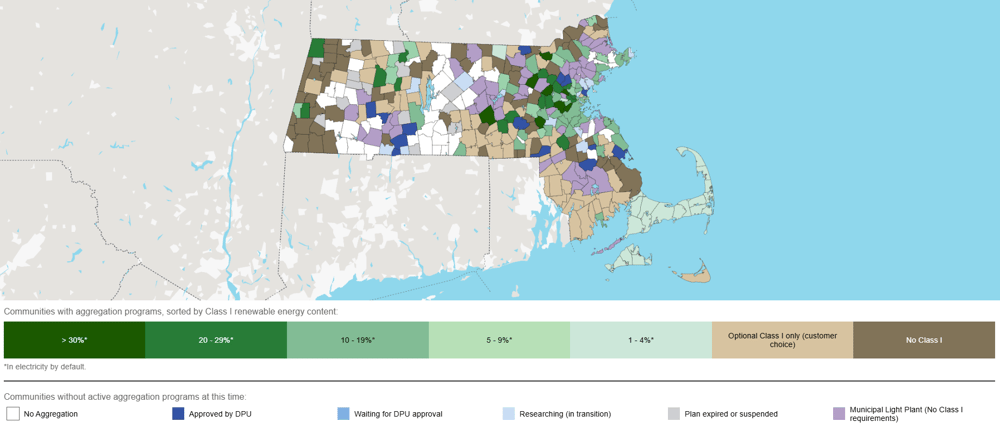
Explore the interactive Green Municipal Aggregation map on our website.
Most Of The Apples In The Barrel Are Very Bad
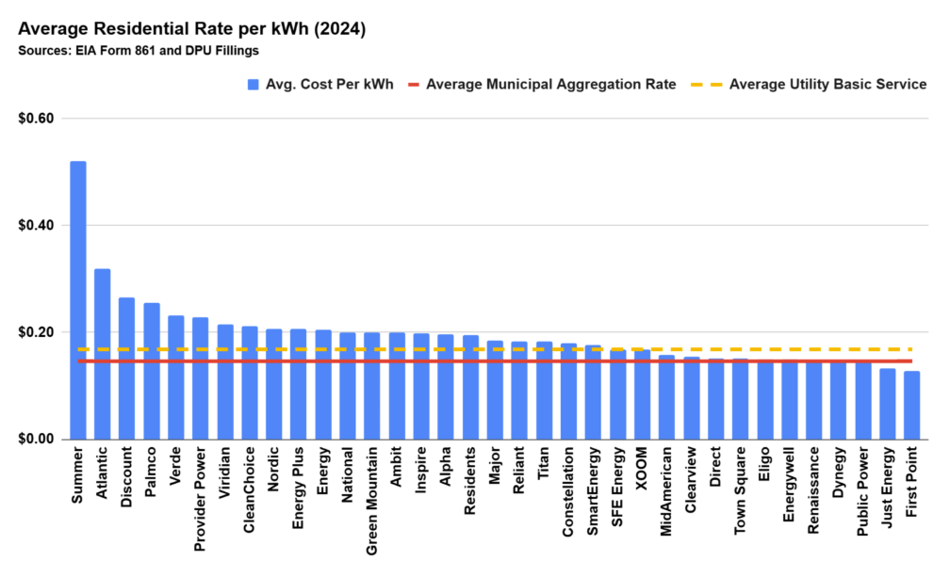
Looking at individual third-party supply companies, Summer Energy Northeast charged the most per kWh at 52 cents, more than three times the average default supplier rate. This means that Summer Energy overcharged its customers by an estimated $366,000, which, spread across its 174 residential customers, results in an average estimated bill increase of $2,100 in 2024.
While Summer Energy charged the most per kWh, Inspire Energy increased electricity bills the most by charging its 63,980 customers an average of 20 cents per kWh, pushing up its customers’ bills by just over an estimated $20 million.
CleanChoice came second behind Inspire Energy, increasing ratepayer bills by $11.3 million. CleanChoice is also notable for the fact that it is currently under investigation by the Department of Public Utilities for deceptive marketing practices and could lose its license to operate in the state.
Average Costs Don’t Tell The Whole Story
One important thing to note with this data is that we only have access to average costs. Many suppliers lure customers in with low initial rates that they then steadily increase over time. These introductory rates can make signing up with one of these companies look better on paper than it is in practice.
We know through customer complaints to the Department of Public Utilities that even suppliers with relatively low average costs charge some of the customers predatory rates. For example, there were complaints lodged against Clearview in 2023, which stated that the customer was being charged between 40 and 49 cents per kWh, even though Clearview’s average rate in that year was just over 20 cents per kWh.
With the above details in mind, here is the average rate information for every third-party electric supplier selling to residential customers in the Commonwealth in 2024.
|
Supplier
|
Average Cost Per kWh
|
Difference from the Avg. Default Rate
|
% Total Third-Party Sales (kWh)
|
Est Ratepayer Impact
|
Megawatt Hours Sold
|
| Summer Energy Northeast, LLC |
$0.52 |
$0.37 |
0.02% | -$326,585 | 893 |
| Atlantic Energy LLC | $0.32 | $0.17 |
0.67% | -$4,351,585 | 26,373 |
| Discount Power Inc. (CT) | $0.27 |
$0.11 | 0.72% |
-$3,123,855 | 28,219 |
| Palmco Power MA, LLC | $0.26 | $0.10 |
0.78% | -$3,091,485 | 30,853 |
| Verde Energy USA | $0.23 | $0.08 |
0.73% |
-$2,240,105 | 28,909 |
| Provider Power MASS, LLC | $0.23 |
$0.07 | 1.53% | -$4,462,795 | 60,311 |
| Viridian Energy LLC | $0.22 | $0.06 | 1.25% | -$2,954,755 | 49,179 |
| CleanChoice Energy, Inc. | $0.21 |
$0.06
|
5.03%
|
-$11,284,270
|
198,226
|
|
Nordic Energy Services, LLC
|
$0.21
|
$0.05 | 0.70% | -$1,436,270 | 27,626 |
|
Energy Plus Holdings LLC
|
$0.21
|
$0.05
|
0.19% | -$379,650 | 7,430 |
| Energy Services Providers, Inc | $0.21 |
$0.05
|
0.63% | -$1,255,580 | 24,744 |
| National Gas & Electric, LLC | $0.20 | $0.05 | 1.36% |
-$2,451,290 | 53,722 |
| Green Mountain Energy Company | $0.20 |
$0.04 |
0.23% | -$396,135 | 8,883 |
|
Ambit Energy Holdings, LLC
|
$0.20 |
$0.04
|
1.05% | -$1,838,220 | 41,276 |
|
Inspire Energy Holdings, LLC
|
$0.20 |
$0.04
|
11.54% | -$20,000,250 | 454,530 |
|
Alpha Gas and Electric, LLC
|
$0.20 |
$0.04
|
0.30% | -$503,780 | 12,004 |
| Residents Energy, LLC |
$0.19
|
$0.04
|
2.74%
|
-$4,253,035
|
107,963
|
| Major Energy Electric Services |
$0.19
|
$0.03
|
1.08%
|
-$1,295,090
|
42,522
|
| Reliant Energy Northeast LLC |
$0.18
|
$0.03
|
8.99%
|
-$10,164,445
|
353,881
|
|
Titan Gas LLC
|
$0.18
|
$0.03
|
1.65%
|
-$1,820,415
|
64,947
|
| Constellation NewEnergy, Inc. ** |
$0.18
|
$0.02
|
6.90%
|
-$6,535,214
|
271,794
|
| SmartEnergy Holdings, LLC |
$0.18
|
$0.02
|
2.83%
|
-$2,313,855
|
111,259
|
| SFE Energy Massachusetts, Inc. |
$0.17
|
$0.01
|
0.86%
|
-$468,755
|
33,679
|
|
XOOM Energy Massachusetts, LLC
|
$0.17
|
$0.01
|
0.79%
|
-$397,515
|
31,087
|
| MidAmerican Energy Services, LLC |
$0.16
|
$0.00
|
0.00%
|
-$395
|
151
|
|
Clearview Electric Inc.
|
$0.15
|
$0.00
|
5.26%
|
$151,855
|
207,121
|
| Direct Energy Services ** |
$0.15
|
$0.00
|
36.49%
|
$4,593,599
|
1,436,719
|
|
Town Square Energy
|
$0.15
|
$0.00
|
3.43%
|
$491,320
|
135,184
|
|
Eligo Energy, LLC
|
$0.15
|
$0.00
|
0.01%
|
$1,050
|
230
|
|
Energywell LLC
|
$0.15
|
$0.00
|
1.03%
|
$197,815
|
40,593
|
|
Renaissance Power & Gas, Inc.
|
$0.15
|
-$0.01
|
0.77%
|
$231,550
|
30,190
|
|
Public Power LLC (CT)
|
$0.14
|
-$0.01
|
0.41%
|
$167,660
|
15,992
|
|
Just Energy
|
$0.13
|
-$0.02
|
0.01%
|
$12,320
|
544
|
We Can Protect Our State From These Companies
The Governor's Energy Affordability Bill, H.4144, while not fully banning third-party suppliers from signing up residential customers (due to continued House opposition to that policy), contained major reforms that could protect many residents from some of these companies’ predatory practices.
These reforms were largely carried over into H.4744, the House Telecommunication Utility and Energy Committee’s energy bill. For reasons unrelated to third-party suppliers, H.4744 is a controversial piece of legislation that is now stalled by the House Ways and Means Committee. While we are glad the House Ways and Means Committee is editing the bill in light of public opposition to many of its pro-utility and pro-fossil fuel policies, we still need to make sure that its positive third-party supply sections are not lost in this editing process.
One of these is Section 42 of H.4744, which would change the state’s purchase of receivable system. As we’ve written about before, this system currently acts as a subsidy to suppliers and makes it so that they have no incentive to make sure their customers can actually pay their bills because bad debt is passed onto all ratepayers, not just their own customers.
Another important part of the bill is Section 47, which would, among other things, prevent suppliers from signing up low-income customers and make it harder for suppliers to automatically renew customers into worse contracts.
Please Call Your State Representative
Third-party suppliers are going to fight every meaningful measure to protect consumers. Therefore, we need State Representatives to hear from constituents that they want to see action on this issue.
If you have three minutes, please call your State Representative (you can find their number here) and tell them you want to see Sections 42 and 47 of H.4744 make it into law. It really does make a difference.
Methodology
* The figure of 7,000 kWh of residential electricity use per year was taken from the Attorney General’s 2025 report on the third-party supply industry.
** This does not include behind-the-meter sales (i.e. mostly rooftop solar) or sales made by municipal utilities.
The Energy Information Administration reports electricity suppliers’ sales to residential customers by both megawatt-hours and revenue. The average price per kWh of electricity for third-party suppliers is calculated by dividing their reported revenue from residential customers by the amount of electricity the supplier sold to residential customers, as reported in Form EIA-861. This methodology does mean that one-off payments (such as cancellation fees), fixed-monthly payments, and other non-volumetric payments are included in calculating the price per kWh figure.
Municipal aggregation figures are taken from reports filed in the Department of Public Utilities’ Docket 26-MA. For suppliers that supply both aggregation and non-aggregation customers, reported aggregation sales, both by kWh and revenue, were subtracted from their reported residential EIA sales to estimate their non-aggregation average price per kWh.
There are three companies that the EIA listed as third-party suppliers that are, to the best of our knowledge, only active as municipal aggregators and did not sell to individual retail customers. These companies were Dynegy Energy Services, First Point Power, and NextEra Energy Services. Power reported to have been sold by these companies to residential customers in excess of what was recorded in municipal aggregation reports is assumed to be either the result of a municipality failing to file its annual municipal aggregation report or suppliers making a mistake in their report to the EIA.
Eversource’s average price per kWh was calculated using the reported Basic Service rates pulled from their website and the Mass. Department of Public Utilities' website. EIA data was not used in this case because Eversource’s EIA revenue data does not appear to be accurate.
A supplier’s average ratepayer savings was calculated by subtracting its statewide average price per kWh sold by the average statewide default supplier price and multiplying the resulting number by the number of kWh that supplier sold to residential customers statewide. Regional variation in where third-party supply, aggregation, and basic service customers live could mean actual impacts vary from our estimates.
Comments