

Liquified natural gas (LNG) terminals are large pieces of infrastructure that can either turn pipeline natural gas into a liquid to move onto ships or turn liquified natural gas into a gas to put into a pipeline. They have recently made national headlines because the buildout of LNG export terminals has allowed the US to export more natural gas to the rest of the world, which in turn has led to higher domestic natural gas prices.
Uniquely for the mainland United States, New England’s LNG facilities are primarily used to import, not export, natural gas. This is because the region’s position at the end of the national gas pipeline system means that pipeline gas alone cannot meet the region’s demand during cold snaps. That is where the Everett Marine Terminal (EMT) comes in.
EMT is not the only LNG terminal in the region, but it is by far the largest. Its location matters too. EMT is in Everett, just outside of Boston, and near two major pipelines, which means that when the region’s gas pipelines are already working at full capacity, it can be the only major facility able to supply additional gas to certain parts of Eastern Massachusetts.
EMT is currently critical enough to the gas system that if it were to suddenly stop working in the winter, it is possible that some gas customers in Eastern Massachusetts would find themselves without gas due to a loss of pipeline pressure. Unlike the power grid, the gas distribution system cannot be easily restarted once an area loses gas, so even a brief shortage needs to be avoided.
Why The Everett Marine Terminal Is A Problem
EMT’s necessity is not itself an issue; the region’s two main interstate gas pipelines are far more critical, and we are not writing a blog on them. What makes EMT an issue is the cost its use imposes on utility gas customers.
In 2024, Constellation, the company that owns EMT, looked like it could close the facility due to falling gas demand and the planned shutdown of its main customer, the Mystic Power Plant.
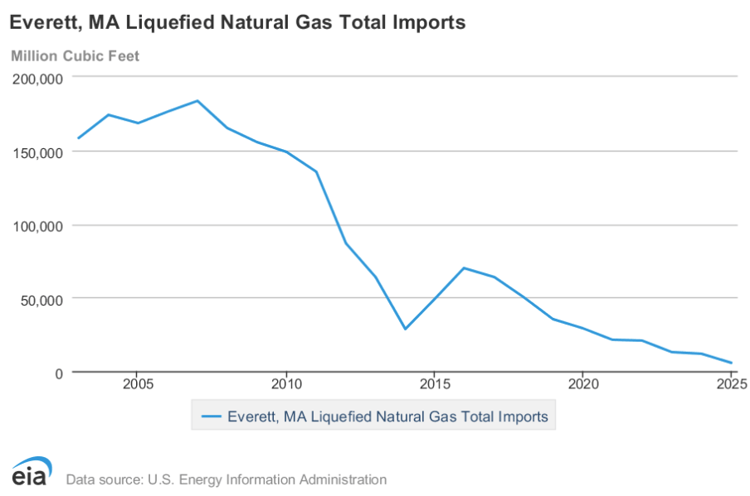
In response, three gas utilities—Eversource, National Grid, and Unitil—signed a 6-year contract with the terminal, which the Attorney General’s Office estimated could cost ratepayers up to $946 million. The purpose stated then and repeated today is that EMT is primarily an insurance policy for when peak demand for gas spikes on the coldest days of winter.
Part of that cost stems from LNG being more expensive than pipeline gas. Another fraction of the contract’s costs comes from the more than $50 million per year that Constellation must spend on fixed costs (regardless of the gas throughput) to maintain and operate EMT according to a 2024 filing.
"Regarding fixed operating costs, DPU CONSTL 1-1(1), Attachment A, Everett Schedule A at Page 13 of 24, contains information regarding actual operating costs of the Everett Marine Terminal for 2022 under the COS Agreement and two years of projected costs for 2023 and 2024. In particular, line number 23 on Page 13 provides a full-year view of the costs from 2022 to 2024—approximately $59.1 million in 2022, approximately $50.4 million in 2023, and approximately $51.7 million in 2024."
But even those two costs together don’t explain why EMT costs ratepayers so much. While gas costs from EMT are often redacted in most documents, one filing from EGMA, a part of Eversource, shows that EGMA pays Constellation $48 million annually just for the ability to buy gas from EMT (this is called a capacity payment), with any actual LNG purchased adding to the bill (the contract is labeled CLNG for Constellation LNG).
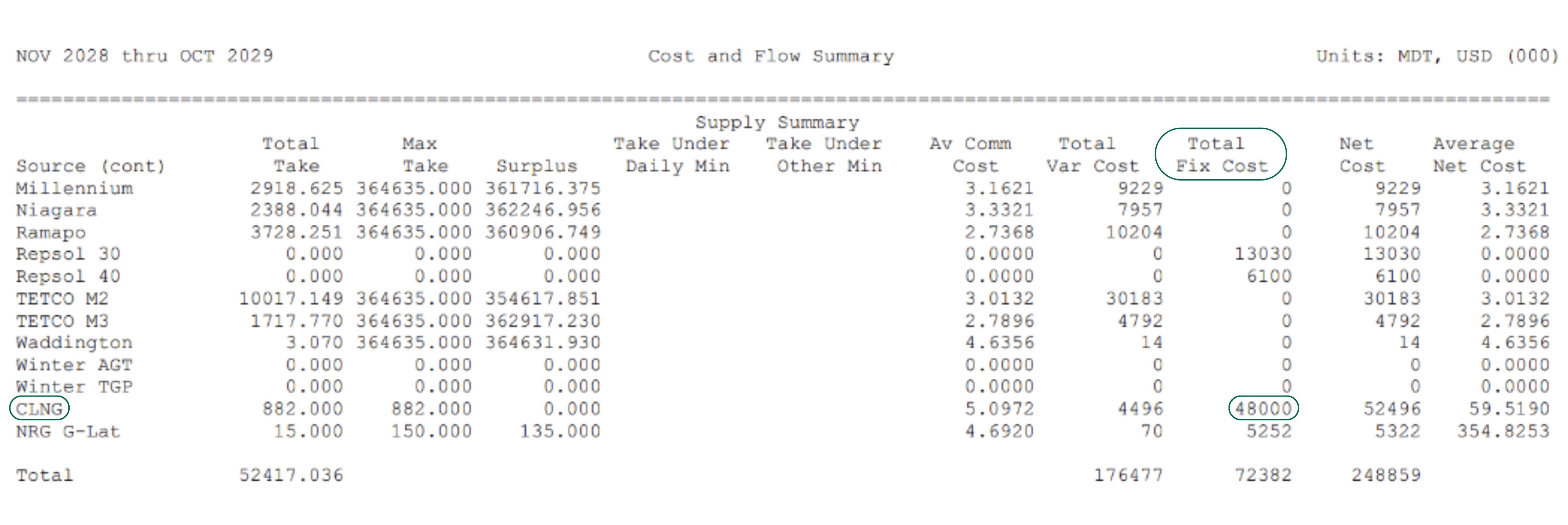
The fact that EGMA’s capacity payment alone is high enough to almost single-handedly pay for the operation and maintenance of EMT is odd, given that it is not the only utility paying Constellation to keep the facility open. In addition to EGMA, there is also another part of Eversource - NSTAR, and three other utilities: National Grid, Unitil, and, a recent addition, Berkshire Gas.
This suggests that Constellation has the ability to set prices without being constrained by either competition or regulation. EMT’s unique position near two gas pipelines in a gas-constrained area means that National Grid and other utilities could not get many of the services that EMT provides from any other supplier, giving Constellation a lot of power in contract negotiations.
Normally, when one company in the energy sector holds that kind of power, state or federal regulators step in and place limits on what that company can charge. For instance, the prices charged by the interstate pipelines that bring gas to New England are regulated by the Federal Energy Regulatory Commission (FERC). FERC used to also regulate EMT’s prices, but that ended due to a change in federal law in the 2000s. However, because EMT still falls under FERC’s jurisdiction, the state equivalent of FERC, the Department of Public Utilities, is not allowed to take over FERC’s old role. This leaves the terminal in a unique—and likely highly profitable—position.
Options For Shutting Down The Terminal
The Commonwealth's gas utilities have three possible responses to this problem:
1. Continue using EMT
One option is for the gas utilities to continue using EMT for the foreseeable future and sign new long-term contracts once their current agreements with EMT run out early next decade. This would give Constellation another chance to profit from its strong negotiating position with the utilities and could impose significant costs on gas customers.
2. Replace EMT
Another option is to invest in new gas storage or transportation infrastructure, which could remove the need for EMT. EGMA is doing so through its contract with the Algonquin Pipeline owner Enbridge. As part of the contract, EGMA, along with several other buyers, has agreed to enter into long-term gas supply contracts. In return, Enbridge will expand the existing Algonquin Pipeline, which will allow more gas to enter southern New England.
The problem with this strategy is that any gas system expansion is ultimately paid for by gas customers. Through this new contract, EGMA’s customers will find themselves paying for part of the cost to expand the pipeline through the supply portion of their bill. Additionally, while EGMA claims that the new pipeline contract will save its customers money because it is cheaper than buying from EMT, those savings would only materialize if gas demand does not fall over the 2030s. If gas demand does fall, EGMA customers will find themselves locked into a long-term and high-priced contract for gas they don’t need.
3. Reduce gas demand
If gas demand falls enough in EMT-dependent regions, then the utilities could become capable of meeting periods of peak gas demand with only gas from existing pipelines. There are several tools that utilities could use to achieve this, including placing a moratorium on new gas hook-ups in EMT-constrained zones and moving customers off the gas system and onto heat pumps. This pathway would minimize financial risks by forgoing the need for new long-term gas supply or storage contracts, it would help the state meet its emission reduction goals, and it would prioritize affordability for current gas customers rather than increasing bills so that the utilities can be ready to serve hypothetical new customers who might want gas in the future.
Also, even though the gas utilities continue to insist on planning for higher gas demand in the future, gas demand has been trending downward (if inconstantly due to weather) for years. This means that a demand-reduction-based strategy may not only be the least risky, but also the options that best take advantage of existing trends.
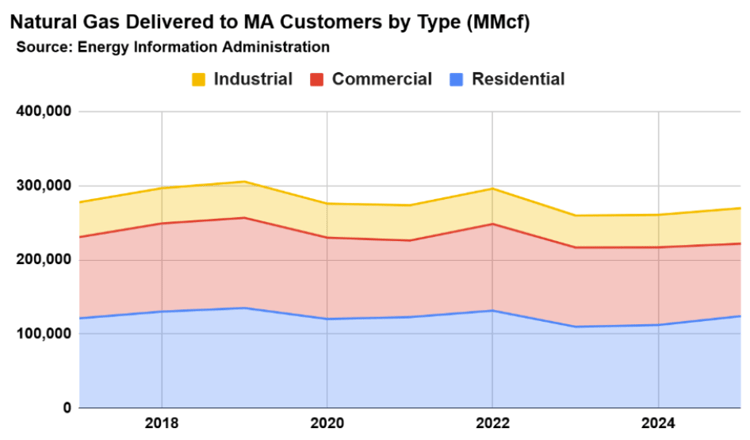
Unfortunately, the gas utilities oppose this strategy because they profit more from expanding the gas system than shrinking it.
The combination solution:
A final option is to use several different strategies in combination. This could mean building electrification mixed with a short-term extension of the utilities of EMT contracts, or a moratorium on new gas hook-ups in EMT-dependent areas coupled with new gas storage tanks to meet peak demand.
How The Commonwealth Can Solve This Issue While Protecting Gas Customers
Due to the twin facts that gas utilities' profits could be negatively impacted by a gas demand reduction strategy and the utilities can pass through the cost of EMT onto their customers, they currently have no real incentive to move away from the terminal. Additionally, even if the gas utilities decided today to work diligently to move away from the terminal, it is uncertain whether they could do so before their current contract expires in 2030. This leaves gas customers vulnerable to the possibility that utilities will need to sign more contracts with EMT, which would give Constellation another chance to set high prices.
Fortunately, there is a way to both incentivize the utilities to move away from using the terminal and to protect gas customers from the cost of any new contracts. Namely, the Department of Public Utilities could make it clear that any utility that needs to sign a new contract with EMT once the current ones expire may not be able to pass along the cost of that contract onto its customers. Rather than customers paying for the high price of gas from EMT, such costs would instead fall on utility shareholders. While disallowing cost recovery, as this process is called, is not common, and it cannot be done without reason, it can be used in situations in which a utility has acted imprudently. And if becoming dependent on a gas supplier that can charge prices unconstrained by either regulation or competition is not imprudent, it is not clear what could qualify.
Finally, it is also worth noting that the Legislature could also help the situation by directing the Department of Public Utilities to consider not allowing post-2030 EMT costs to be passed on to customers. Such an action would send a clear signal to the utilities that they cannot burden their customers with another overpriced EMT contract in the future.
Comments