


As summer approaches, thousands of our followers prepare to “Shave the Peak.”
Subscribers to our Shave the Peak program will receive text and email alerts about how and when to reduce power use on days when electricity demand is significantly higher than usual. As we begin to see temperatures rise above 90°F this summer, more people will turn on their air conditioners to stay cool. This increased electricity demand leads to the grid operator having to call on more expensive and polluting power sources such as oil- and gas-fired “peaker plants". These fossil-fuel-powered peaker plants contribute only a fraction of our electricity over the course of the year (about 2-7%) but have an enormous impact on energy prices and air pollution.
In the New England power system, summer peak demand often occurs just as solar power production tails off at dusk, and it’s still hot, usually around 6 PM. Shave the Peak alerts often recommend saving energy during that timeframe, usually 4-8 PM, with an emphasis on 6-8 PM depending on the day’s specific conditions.
Shave the Peak Alerts
How do we determine when to send peak alerts? We will be watching the weather and electricity demand forecasts from ISO-New England, the non-profit Independent System Operator responsible for maintaining reliable electricity to the six New England states. (You can track this data through ISO’s website or ISO-to-go app.) When New England’s demand is expected to rise over approximately 20,000 megawatts (MW), we will typically call a peak event.
Yes, it’s the air conditioning.
The graph below from ISO-NE is a 21-day hourly load forecast from last year between June 17, 2025 and July 7, 2025. The blue line represents the hourly load forecast (energy usage measured in megawatt-hours, or MWh), and the orange line represents the temperature. The chart shows how, as summer temperatures begin to rise, peak demand rises in correlation with it. While the average household might use about 600 kilowatt-hours (kWh) per month over the entire year, usage rises significantly in the summer. You can also see how demand ebbs and flows each day. Note how their forecast accurately predicted that June 24 would be a scorcher and peak day – more than any other day last summer. Wholesale power prices skyrocketed. Check out our blog about summer 2025 peak demand trends to learn more.
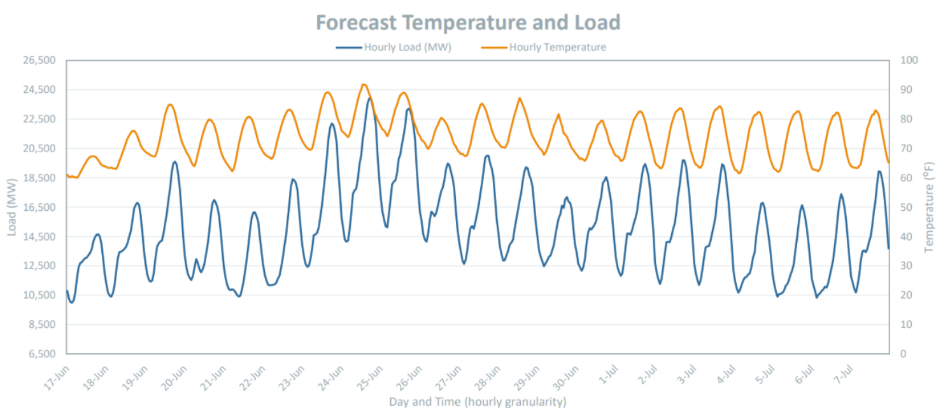 ISO-NE 21-day hourly load forecast for June 17 through July 7, 2025
So Far This Summer
The following graphs compare the system load and resource mix between Saturday, May 16 (high of 74 degrees) and Tuesday, May 19 (high of 92 degrees). While comparing the graphs, note the difference in scale between the y-axes.
Saturday, May 16th, was the warmest day of the month so far, but it wasn’t hot enough for most people to turn on their air conditioners. And being a Saturday, commercial and industrial power use was low. The peak system load that day was about 12.5k MW.
Tuesday, May 19th, three days—and twenty degrees—later, the system peaked at almost 19k MW. Subsequently, prices shot through the roof (with a peak at about $215/MWh), as did CO2 emissions, which more than doubled at their peak. The resource mix on Tuesday sheds some light on that. Natural gas use, which rested at about 3.5k MW on Saturday, almost tripled on Tuesday, which led to a surge in both prices and emissions.
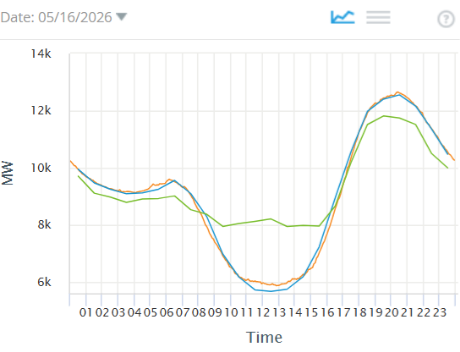
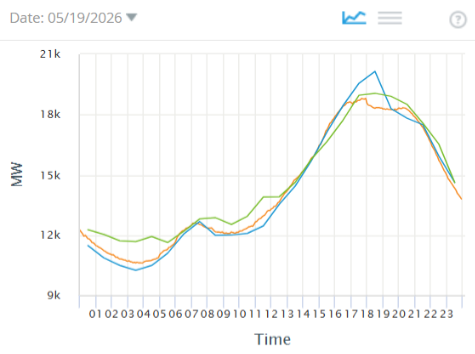
System Load in MW (Actual, Forecast, Cleared) for May 16 (left) and May 19 (right)
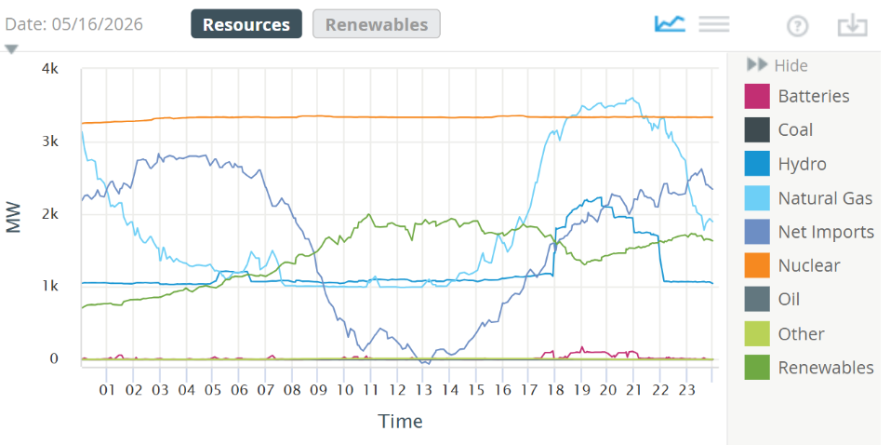
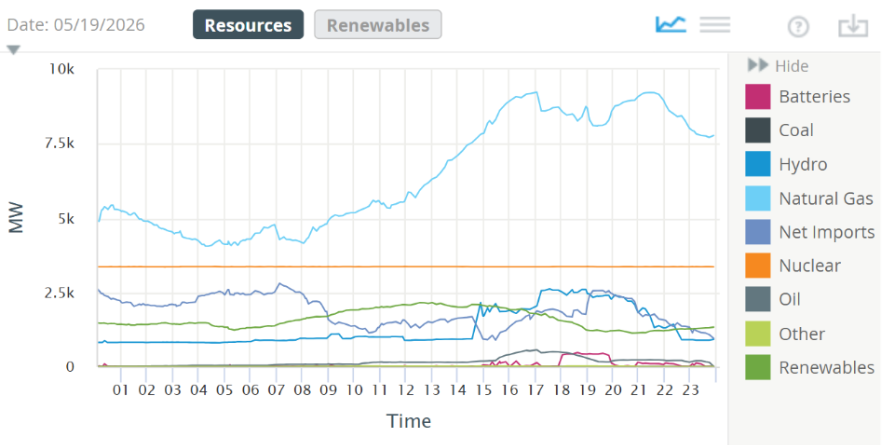
Resource mix in MW for May 16 (above) and May 19 (below)
But the season is just getting started. ISO put out its most recent 21-day hourly load forecast on June 3. The more recent 21-day hourly load forecast graph shows peaks approaching 18,500 MW. However, the actual peak temperatures during the past week have already exceeded those in the graph, resulting in us calling a peak day on Thursday, June 11th. The higher we go – the more pollution we create and the more we pay for power generation.
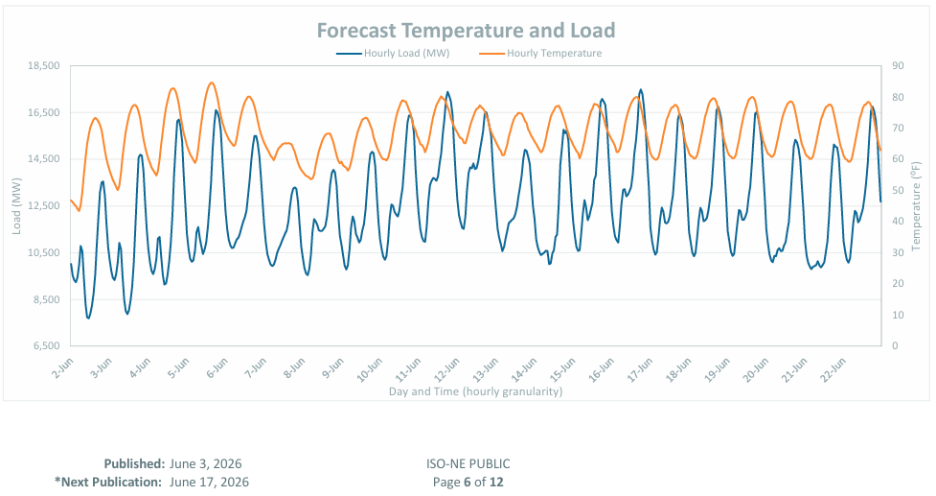
ISO-NE 21-day hourly load forecast for June 2 through June 22, 2026
How to Shave the Peak
If you are enrolled in our Shave the Peak program, we will text you a friendly reminder to do what you can to curtail energy consumption during peak hours. The highest peak on a sunny day might be about 6–8 PM, because, as shown above, we have a lot of solar on the grid nowadays, which reduces the need for fossil fuels in the earlier hours, but our participants try to keep electricity use low before and after the highest peak, just in case.
Typically, if we receive information that the peak will occur on one particular day or two, we let participants know via text, email, and social media.
Here are practical ways to "shave the peak" during those specific hours:
-
Pre-cooling works! Focus your AC usage on a couple of rooms and get them nice and cool before 5 PM. Then, turn the AC up a few degrees, or turn it off if you can handle it.
-
Use fans wherever possible to compensate for AC and draw the blinds to help keep rooms cool. If you're planning an outing to the pool or to the air-conditioned library or mall, do it during peak hours!
-
Don’t do the laundry. When you do, wash in cold water.
-
Don’t run the dishwasher.
-
If you have an electric car, schedule your charging session for 9 PM to 7 AM. Avoid peak times!
-
Sign up for Shave the Peak to get reminders to reduce your electricity use when it matters most.
Note: Our air would be cleaner, and we would be paying a lot less for power if we always shifted power use to off-peak hours. It’s especially important when the weather is this hot. Why not start practicing now?
|
Ask About ConnectedSolutions ConnectedSolutions is a demand response program that incentivizes homeowners to reduce energy consumption during peak demand periods. Participants can earn rewards by allowing their smart thermostats or battery storage systems to temporarily adjust energy usage during peak times, helping to stabilize the electric grid and reduce carbon emissions. For information, contact your local utility: Eversource, National Grid, Unitil, and Rhode Island Energy. If you have National Grid or Eversource, check out our upcoming webinars on their programs. |
The Future of Peak Shaving
Very briefly, peak shaving should evolve into something bigger and better. Utilities in Massachusetts and Rhode Island are beginning to install “smart meters” that will take programs like Connected Solutions to a higher level. For more information on smart meters, watch our webinar. We can expect to see time-varying rates and more load management programs to incentivize efficient energy use. The idea is to shift financial rewards away from dirty, expensive fossil fuel peaker plants and direct them to participating consumers. Making these changes will benefit consumers by driving down the system-wide costs that we all pay for.
More To Come
We will do another Shave the Peak blog in a few weeks as temperatures rise. And we’ll explain the “Duck Curve” and how rooftop solar and batteries help to reduce demand for fossil fuels during summertime peak hours.
Comments