

When an investor-owned utility, like National Grid or Eversource, builds an electric substation or makes some other infrastructure investment, it takes on debt to do so and then pays off that debt over time through revenue raised from ratepayers' bills. Before it is paid off, utilities use a mix of low-interest bonds and more expensive equity funding from their shareholders to finance their debt. This use of high-cost equity financing sends money to utility shareholders (which encourages people to invest in the utilities) but burdens ratepayers with higher bills.
As we’ve written about in the past, securitization is an alternative method for financing utility investments. It relies more heavily on low-interest bonds than standard utility financing. Using more low-interest bonds can cut financing costs, which make up a substantial portion of utility bills, saving ratepayers money. When done well, securitization shifts who benefits from our energy system away from utility shareholders and Wall Street to utility customers.
The savings securitization makes possible have caused it to be used across the country, including in Massachusetts, where it helped manage the costs that came from reforming the state’s utilities in the late 1990s and early 2000s.
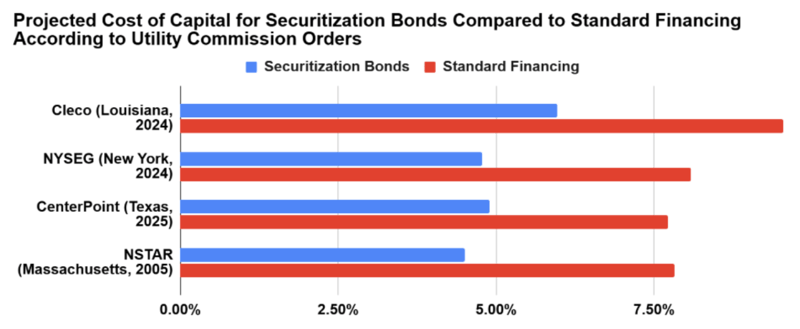
Securitization's ability to lower rates is why both the Governor and Mass State Senate included it in their versions of the energy affordability bill (the Senate and House are currently negotiating to find a compromise version).
Despite the benefits of securitization, the concept does have its opponents. For example, we recently read an op-ed written by a consultant who is connected to National Grid. Below is our response to the three biggest concerns with securitization outlined in that piece.
Securitizing Mass Save’s cost would increase bills over the long term.
If securitization is used to extend the repayment timeline for a pile of debt, it could increase bills over the long term, since longer repayment timelines lead to higher financing costs (because you are borrowing more money for longer). The op-ed author raised the possibility that securitization could increase rates in that manner by turning the energy efficiency program Mass Save from something whose full costs are quickly passed on to ratepayers (and thus doesn’t incur significant financing costs) to one which is paid off over years. While this would be a problem, the securitization language already in the Senate bill addresses this issue by requiring that securitization proposals need to be cost-effective to be approved by the Department of Public Utilities. Under any reasonable interpretation of that cost-effectiveness requirement, securitizing Mass Save’s costs would not be allowed because doing so would likely increase bills over the long term.
Securitization hurts utilities’ credit ratings.
That same commentator also brought up the possibility that securitization could harm the creditworthiness of the utilities, which would increase their borrowing costs and lead to higher bills. It’s worth noting here that recently two New York utilities securitized $680 million in storm-related debt, saving ratepayers $92 million dollars. One of the reasons the utilities did this, in addition to lowering customers' bills, was because they believed it would improve their credit ratings by allowing the utilities to get a growing pile of debt off their books.
The idea that securitization also degrades utilities' credit ratings would be news to S&P, one of the big three credit rating agencies, which has written that:
“Furthermore, securitization often results in improved credit measures for the utility. Because securitization bonds are typically recovered through a dedicated source of revenue--in the form of an irrevocable, non-bypassable charge on the customer's bill with full recovery mandated by statute—S&P Global Ratings will often deconsolidate (i.e., remove) securitization debt from the utility's balance sheet. Accordingly, this improves a utility's financial measures and credit quality.”
Securitization shifts risks to customers.
When debt is securitized, it moves from the utilities’ books into a special purpose entity (which is the entity that goes out and secures the low-interest bonds, which is to replace the utility’s equity investment) whose debt is paid down by ratepayers. This explicitly moves responsibility to repay the debt to ratepayers and away from utilities. The op-ed writer argues that this should be another reason to oppose the Senate’s proposal.
However, the op-ed author overstates the importance of this transfer of risk. In practice, utility investments tend to be extremely low-risk, and even when things do go wrong, utility customers often pick up the tab anyway (for an example of how utilities can get help when they run into trouble, in the 1980’s Massachusetts ratepayers had to pay much of the construction costs for the Pilgrim II nuclear reactor even though the utility never finished building it). Assuming the Department of Public Utilities makes reasonable decisions when it comes to when securitization can be used, the cost savings would be well worth the small transfer of risk.
Conclusion
While securitization is not a silver bullet to the high cost of energy in the Commonwealth, we applaud the Healey Administration for championing the idea of bringing back securitization and the Senate for including it as part of their energy affordability bill. This mechanism, if used well, can reduce bills by lowering financing costs and reducing our state’s generosity to utility shareholders.
Our organization intends to put securitization on the table for debate in Rhode Island during the 2027 session of the state legislature.
Comments