

Since both chambers of the Massachusetts legislature passed their energy bills, there has been a lot of focus on the differences between the two bills and where the House and/or Senate bill would harm our ability to fight climate change. That scrutiny is warranted. Our view is that both bills contain many good policies and that it would be a shame if lawmakers did not pass an energy bill this session and had to start the process over again in January.
So here are two areas that we haven't written much about in the past that are in both House and Senate bills, and which we think could move the needle on affordability and climate.
Fixing Basic Service
In most of the Commonwealth, there are two parts to most electric bills: the distribution section, which pays for utility infrastructure and maintenance, and the supply section, which pays for the power itself. While the distribution part of the bill is always handled by the utilities, customers have the option to buy electricity supply from third-party suppliers, municipal aggregation programs, or through the utilities, which is called Basic Service.
In recent years, the number of Basic Service customers has fallen to just over 250,000 as residential customers have migrated to the increasing number of municipal aggregations across the state, often because those programs tend to offer lower rates.
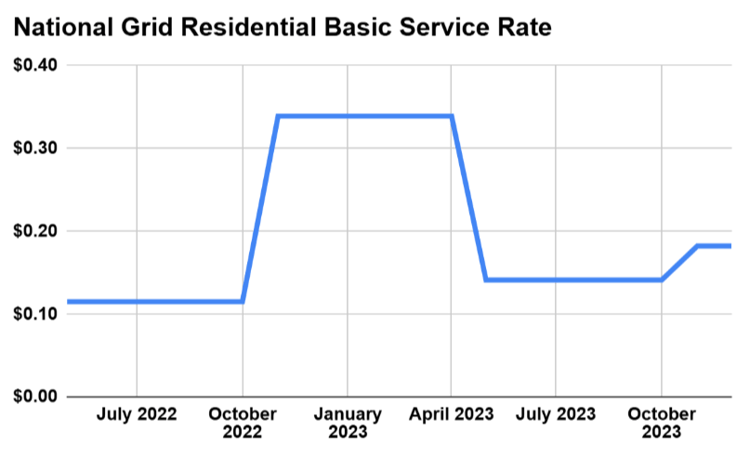
There are two main reasons municipal aggregation programs have managed to outcompete basic service on price. One is that aggregation programs sign long-term contracts which can keep rates flat even when power prices are spiking. This is unlike utilities, which buy power for basic service through short-term contracts, leaving them exposed to price spikes. One dramatic example of this was when National Grid almost tripled its residential Basic Service rate due to high power prices in 2022, which were in turn driven by high natural gas prices (it's almost like natural gas dependency runs counter to affordability).
The second is that the way the utilities structure the auctions at which they buy the power to supply Basic Service customers has resulted in only a handful of power suppliers taking part. Synapse Energy Economics recently produced an important paper pointing out that suppliers are charging a higher premium than ever—with the premium defined as the difference between the retail price and the wholesale price of power (shown in the red bar below).
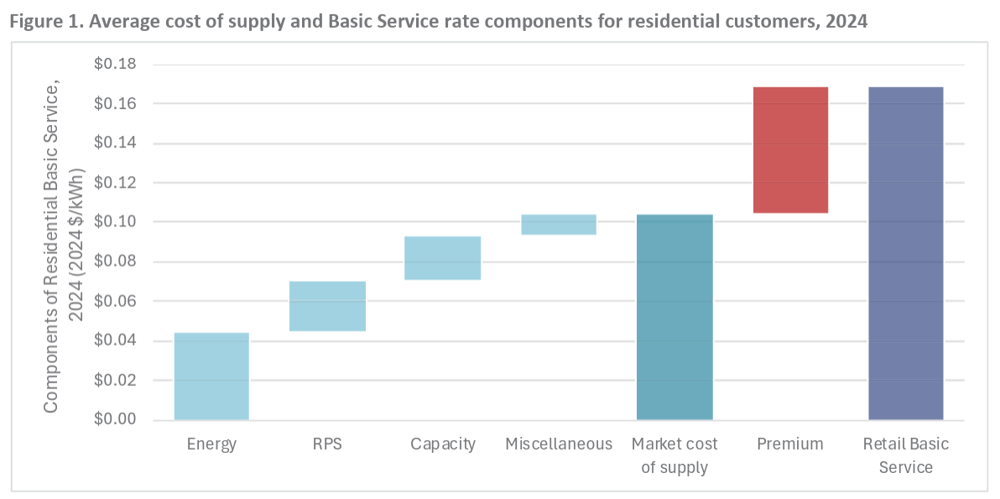
Basic Service cost premium. Taken from the Synapse Report.
Synapse estimates that premiums charged by the companies supplying Basic Service increase bills for residential customers on Basic Service by $22 a month. Eliminating even part of that would be a victory for ratepayers.
That is why it is good to see that both chambers have included language in their energy affordability bills that would give the utilities more flexibility when signing power supply contracts. Not only could that reduce how often utilities need to sign contracts when prices are high, but it could also allow them to reduce their dependency on a small number of suppliers.
Flexible Interconnection
Anyone building a clean energy project needs to consider not just the cost of building the project but also of connecting it to the electric grid. Interconnection costs, as these costs are called, can often render formerly promising projects uneconomical. Fortunately, there is a way to mitigate this cost and get projects connected to the grid faster: flexible interconnection.
In both regular and flexible interconnection, the project developer would tell the regional grid operator or the local utility that they are building a project and need to be hooked up to the electric grid. The regional grid operator or utility would then tell the developer how much the infrastructure would cost to connect to the grid.
The difference with a flexible interconnection agreement is that rather than building a system that can take power from the project and put it onto the grid all the time, the goal is changed to only putting power onto the grid under most circumstances. This change can dramatically reduce interconnection costs, which can be worth it for the project developer, even if it means their project will occasionally be disconnected from the grid. Texas has been using flexible interconnection for years, which partly explains why the state has seen a massive buildout in solar, wind, and battery systems.
Both the House and Senate bills would require the state's major utilities to offer flexible interconnection as an option to developers, hopefully allowing the Commonwealth to one day see the same buildout of renewables managed by the tree huggers in Texas.
That's not all.
The House and Senate energy bills would make progress on a variety of other issues - third-party electric supply regulations (reducing the harms caused by predatory and greenwashing electricity suppliers), consumer protection for solar customers, cutting red tape for solar installations to reduce costs, legalizing plug-in-solar, giving a boost to “virtual power plants,” and ending support for new gas-burning units through the Alternative Energy Portfolio Standard.
That doesn't mean any bill is a good bill.
We are not trying to argue that the Senate (which passed the more pro-climate energy bill) should give the House whatever they want to get a bill done. The House's proposal to cut a billion dollars from Mass Save's current budget, which in practice would mean shutting down most of the program in 2027, is still a terrible idea. Not only would it harm the state's energy efficiency and decarbonization efforts in the short term, but it could cause many of the skilled workers the state needs to decarbonize to lose their jobs and either move or switch fields, which would cause long-lasting damage.
It would be great to see the House and Senate pass an energy affordability bill this session, but the residents of the Commonwealth deserve a good one.
Comments